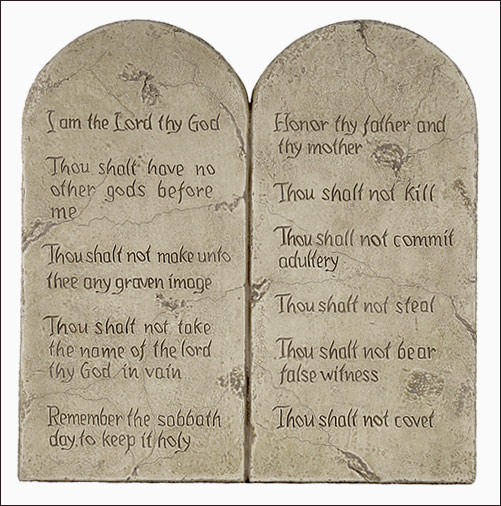
 In the Old Testament, God gave Moses the Law so that the Hebrews could be His people and He could be their God. Most people are familiar with the 10 Commandments, but there were many others. You can read page after page in Leviticus and Deuteronomy about what to do if your bull accidentally kills one of your neighbors sheep and other such unlikely events. Many laws were simply about calling the Hebrews out to be different from the culture they lived in. Every now and then, some well-meaning Bible teacher wanders into the Levitical law and comes out preaching a sermon about how God does not want us to eat catfish. Some people make the argument that it’s all impossible to understand, and that we could never keep all of the law. That conclusion would be exactly the correct one to reach.
God did not give the Law so that we could keep each one and be righteous. The Law was given so that we could see our failure to live righteously on our own. The 10 commandments are like a meter stick to see how far we fall short. God requires perfection. We cannot achieve perfection; we need someone to do it for us. This is the good news (gospel) – Christ has done it for us. He lived a sinless life, died on the cross as our sacrificial lamb, and we can receive the credit of his righteousness. Christ has fulfilled the Law. It’s complete in Him. You don’t need to go through Leviticus with a Sharpie crossing out the ones that don’t apply to you. We lie, we steal, we covet, we commit a multitude of sins; and the blood of Jesus Christ covers them. When God looks on the heart of a believer, that’s what he see and not our sin.
A seeker once asked Jesus which of the commandments was greatest. He said that it was to love God with all of your heart, mind and strength. And the second was like it, to love your neighbor as yourself. If we do these to things, it is impossible to break any one of the 10 commandments. These two principles should be our guide. Jesus lived for out for us the example of a life without sin, and we are instructed to be imitators of him. We cannot do it perfectly; but becoming Christ-like is the goal.
 The Master's Table
So conclusion is that we should still strive to sin as little as possible, right? And sin does include eating catfish, pork etc, right?
Hi, I’m a messianic jew… 😉
Acts 15 makes it clear that gentiles are not required to keep everything. We jews are. We can never keep it all, we can only try as much as possible and let Jesus cover the rest with his blood. And I still believe that the blessings of keeping God’s commandments are still effective, jews and gentiles alike. Including celebrating the feasts of the Lord.
Happy Sukkot.
Dude I know,
Yes it’s true, in Acts 15 the Jerusalem council meets and decides that a gentile need not first convert to Judaism before becoming a Christian. But what about Acts chapter 10? Peter has a vision of a whole collection of animals that were unclean for Jews to eat, and 3 times is told to take and eat. He is told “Do not call common what God has declared to be clean.” By the end of chp. 10, Peter preaches that God shows no partiality, and at that time the Gentile believers receive the Holy Spirit. Now, I am obviously not a Messianic Jew, but it seems to me like an Orthodox Jew would be required to keep all the Kosher laws, but a Jew that believes in Christ and receives the Holy Spirit is free from the Old Testament Law the same as every other believer. Can you resolve this? If Christ has fulfilled the Law and the Prophets, why is it sin for you and I to sit down and split a catfish?
Christ has fulfilled the law, but the law is still there. I believe that God will forgive me if I don’t keep the commandments – but I also think he will forgive me if I do keep the commandments. I don’t keep it because I think that it will save me. I keep it because of my love for God, and I am always careful not to make it more important than my spiritual life, but rather deepen it, as I can always find deeper spiritual meaning with each and every one of the laws I keep.
The sacrifices were never a command – they were ways to get cleansed of sin. This is obviously something we no longer need because Jesus was the Ultimate Sacrifice.
Having said that I will explain Acts 10 from my point of view. In Genesis God told Noah to eat any animal. Are animals are clean. In Leviticus 11, it doesn’t say that the forbidden animals are unclean – it says that “FOR YOU” they shall be unclean. For us jews. They are still clean to others. In acts 10, God was showing Peter that also people for whom these animals are clean (gentiles) are to be accepted as believers, without being required to convert to judaism and keep all the laws.
Clark,
I have two issues with this.
Firstly, why did God make us imperfect and then require perfection and punish us for not living up to His requirements? If He’d made us perfect surely we wouldn’t have fallen? He didn’t fall so He obviously has something we lack.
Secondly, if I’m understanding correctly, the blood of Christ covers all sins except one – that of not believing in him. Murder, rape, genocide, even masturbation, all forgiven with no repercussions as long as you’re a born again Christian. God may not like it, but He lets you off because you’re Christian.
This seems very back to front to me! I believe in freedom of belief. Free meaning no punishment (real or threatened) for making an honest mistake and believing the “wrong” thing.
Eshu,
I’m going to stay away from the terms “perfect” and “imperfect” in my reply here, and use terms such as sinless and sinful instead.
God created man sinless, but He did not create man incapable of sinning. As stated in this post the great commandment is to love the LORD your God with all your heart, soul and strength. So, the question arises, can one really love a person if he is incapble of hating that same person?
lonelypilgrim,
Thanks, I see what you’re saying and I think you’re wise to avoid use the of the word “perfect”. However, He could have made us (or at least Adam and Eve) smart enough not to sin, as He is.
As it stands it seems we are incapable of not sinning.
I agree with Eshu on this point: we are incapable of not sinning. This has been true in my experience. And when he said “He (God) did not fall, so he obviously has something we lack,” that is the understatement of all time and eternity.
God’s standard of righteousness to come into his presence is nothing less than perfection. But the same God who made us imperfect, freely offers the righteousness of his Son to anyone who will accept it. That’s the gospel message. It’s not about what we DO, it’s about what He has DONE.
Note also this difference between the Law and the Gospel: the law is a cold, dead thing. Love is alive, love is warm, love is action. Not breaking the law and loving God and your fellow man are two entirely different things. The Law does not love; if you keep it or not it cannot feel and does not care. The existence of the Law only serves to make us guilty. God does love, even when we don’t love him back, which hurts him. When we love God, the love is felt both ways.
Confucius had a Golden Rule similar to the one Jesus gave, but not exactly the same. Before the time of Christ, Confucius said “Do not do to another what you would not want done to you.” Jesus’ rule was “Do unto others what you would have done to you.” The Confucian rule is negative. “Do not…” You could do nothing and keep this command. The Christian rule is proactive; doing nothing is not good enough. We must actually go out and do good things for others in order to obey.
Why go all the way to China? Rabbi Hillel said exactly the same thing, and he was only one generation before Jesus. Jesus most probably had Hillel and not Confusius in his mind. 🙂
Dude,
I had the same thought about Hillel. The story is that he was asked by a Gentile to explain the Torah while standing on one foot. He stood on one foot and said, and I’m paraphrasing now, whatever you don’t want men to do to you don’t do to them, this is the Torah, everything else is just commentary.
Of course, as Clark stated it is stated negatively and Jesus turned it around and stated it positively and I would say that it holds one to a higher standard. In the parable of the Good Samaritan only the robbers violated Hillel’s command, but the thieves as well as the Priest and Levite violated Jesus’ command.
Exactly! The total story involves the gentile first asking that from Shamai. I will quote a little from Risto Santala’s book in this matter:
The idea of loving one’s neighbour in the Bible is founded upon the twice repeated injunction in Leviticus 19: “Love your neighbour as yourself” (vv 18 and 34). Jesus interpreted this as an active challenge: “Do to others as you would have them do to you” (Luke 6:31 and Matt. 7:12). In some modern translations attempts have been made to substitute “as much as you . . .” for “as you . . .”, but the Bible is not speaking about measuring the amount of love, rather about its correct motivation.
There are two stories in the Talmud which touch upon the interpretation of this ordinance. A certain man of Gentile birth went first to R. Shammai, an exponent of the more rigorous line, and asked:
“How many Torahs do you have?” “Two”, Shammai replied, “the written and the oral Torah”. “I believe,” the Gentile remarked, “in the written Torah, but not in the oral. Make me a proselyte but teach me only the written Torah.” Shammai rebuked him and sent him off. The same man went to R. Hillel, who took him as a proselyte and began to teach him the Torah. Another stranger came to Shammai and said to him, “Make me a proselyte and teach me the whole Torah as I stand here on one leg.” Shammai drove him off with a builder’s rod, for he was a builder by trade . . . The same foreigner came to Hillel, who accepted him as a proselyte and said to him, “Whatever you yourself hate, that do not do to your neighbour: in this is the whole Torah. The rest is but comment upon it. Go and take it as your guide!”20
Hillel, who lived a little before Jesus’ time, recieved the appellation “the Meek” on account of his friendly approachability.
The Jerusalem Targum also says, “Do not do to your neighbour what you yourself hate,” and in the Didache, the “Teaching of the Twelve Apostles”, we read:”What you do not wish done to yourself, you should on no account do to others” (I,2). This little guide to the teaching on baptism, written, it would appear, at the beginning of the second century and known to the church historian Eusebius, contains an issue which is of importance for our day: “Do not destroy the foetus, neither kill it after it has been born” (II 2).
The Rabbis’ exegesis of the law generally aims at establishing the minimum expected from us by God, which is why love for our neighbour is seen from the negative point of view of “Thou shalt not!” Jesus taught an active, unreserved attitude: Do, Love, Give, Lend, Pray, Have mercy! Could it be that Jesus was familiar with the words of R. Hillel above, since the final cadence to his instructions is, “In everything, do to others what you would have them do to you, for this sums up the Law and the Prophets” (Mt 7:12)?
As the Messiah Jesus also gave the teamei Torah, a new impulse to its teaching. Twice in John’s gospel we find a phrase which raises neighbourly love to the new level of the ideal. We read in 13:34: “A new commandment I give you: Love one another. AS I have loved you, so you must love one another,” and in 15:12: “My command is this: Love each other AS I have loved you”. This commandment to love one another is not actually new, but it is given a fresh impetus in following the example of Jesus: “as Jesus did”! Love is not self-seeking but makes the affairs of others its own. Love does not search for those who are on a par with it, but raises its object to equal status with itself. Jesus alone has realised the royal commandment of love in giving his life as a ransom for it.
Source: “THE MESSIAH IN THE NEW TESTAMENT IN THE LIGHT OF RABBINICAL WRITINGS” by Risto Santala. Available free online at
http://www.kolumbus.fi/risto.santala/rsla/Nt/index.html
Above quote from teh chapter “The teaching regarding love for one’s neighbour” (chapters are on the right side navigation).