Mike’s visit to Tate’s Creek Presbyterian leads to some thoughts on traditional music. A conversation on the Boar’s Head Tavern begs the question “What is the purpose of Sunday a.m. worship?” Then a discussion on New Testament church membership. Part of that discussion includes how missions become churches.
The end of Hebrews 4 informs us that Jesus is our Great High Priest and then the chapter ends. Hebrews 5 tells us why he is a better high priest than the Levitical priests of the Old Covenant. The high priests called by God to the priesthood were human beings and had the same shortcomings as the people they ministered to. They had their own sins to confess and be forgiven before they could attend to the sins of others. The Christ is God’s own Son and also a priest forever after the order Melchizedek. Abraham was blessed by Melchizedek in Genesis 14 and Abraham gives him a tenth of everything he has. This is centuries before the Law was given to Moses. The Levitical priesthood had not been established and there was no commandment, at least none recorded, to give a tithe. Genesis will not answer all of our questions. There is no recorded beginning nor ending of Melchizedek’s priesthood and this little detail is used to show what kind of high priest Jesus will be. There is no beginning and no end to his priesthood. He does not have his own sins to sacrifice for, and he is not called by God but is God’s own Son. Although he was the only begotten Son, through suffering in his mortal flesh he learned obedience.
The final verses of chapter 5 is a chastisement to an audience that should be eating “spiritual food” as mature believers but must still be given milk as infants. Hebrews will get to comparing Jesus to Melchizedek in a couple of chapters and list more ways in which he is greater.
I first thought this was a parody, then I really hoped it was a parody. But no, this is a real product. You can cover your flute, saxophone, oboe and more. Click here to visit McCormick’s Instrument Covers and “hold the germs, not the sound.”
In this episode, Michael plugs The Theology Program from Reclaiming the Mind Ministries. If you are familiar with Credo House Ministries or the Parchment and Pen blog then you will recognize the name C. Michael Patton. He does all those things and more and is not hard to find online. Michael then responds to “Why all the Lutheran stuff?” The short answer has to do with getting the Gospel right. Then a segue into a discussion of The White Horse Inn which leads to the thrust of this podcast episode which is the post-evangelical experience. Is post-evangelicalism focused on individualism? Does post-evangelicalism work in a church based setting or will always look like one vs. the world?
The key to understanding Hebrews 4 is to have read Hebrews 3. The basic concept presented in chapter 3 is that Jesus is greater than Moses. The chapter ends with God’s people not entering the rest they were promised because of disobedience:
For who were those who heard and yet rebelled? Was it not all those who left Egypt led by Moses? 17 And with whom was he provoked for forty years? Was it not with those who sinned, whose bodies fell in the wilderness? 18 And to whom did he swear that they would not enter his rest, but to those who were disobedient? 19 So we see that they were unable to enter because of unbelief. Hebrews 3:16-19
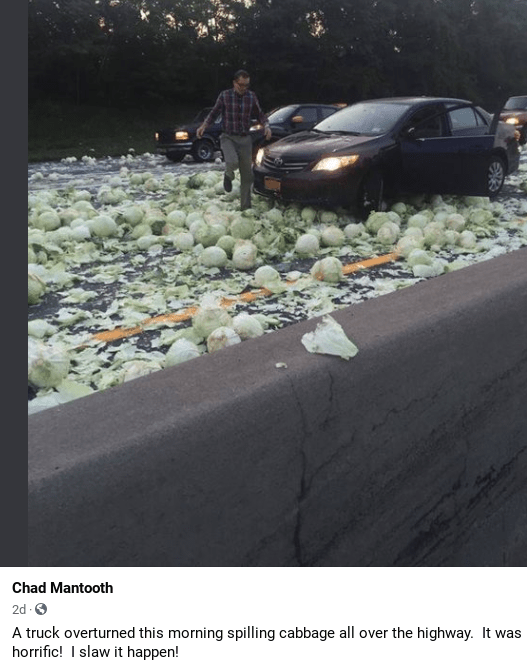
2020 huh? Sometimes it gives you global pandemics or category 4 hurricanes. And sometimes cabbages spill all over the highway. It’s like the gift that keeps on giving… gifts that no one wants and can’t be returned.
Each podcast will mention a few brief items in the opening minutes then focus on a topic for the bulk of the session. In this episode Michael introduces some new (at the time) music, talks about his daughter moving back to Oneida to teach and discusses the difference between religion and the gospel based on Tim Keller. Then he gets into what to look for in a church if you are on the same post-evangelical journey that he was on. Michael Spencer adored worship, when done correctly, just not worship of the institutions.
Moses is perhaps the most significant type of of Christ in the Old Testament. There are many examples of types of Christ given, such as the high priest, the sacrificial lamb, the branch that was thrown in the bitter water at Mara. Moses had a great many things in common with Christ; he led the Hebrews out of slavery in Egypt, gave them God’s Law, and led them through the wilderness to the Promised Land. Some teachers go as far as to point out that Moses was taken out of the water by Pharaoh’s daughter and Jesus was taken up from the waters of baptism by John the Baptist. That might be a stretch… but those things did happen. Jesus frees the Christian believer from slavery to sin, teaches us God’s Law (kept it perfectly so we don’t have to actually), and leads us through this present wilderness we are in toward the promised land of God’s Kingdom.
Last week we speculated on the possibility of having two hurricanes in the Gulf of Mexico at the same time. While that historic event did not occur, Hurricane Laura became one of the most powerful storms to ever make landfall in the United States. Laura was a strong category 4 hurricane, almost a cat 5. Katrina, for comparison, was only a 3. Pray for everyone that has been and continues to be affected by this storm. It will soon be time to put our differences aside and go be the body of Christ. So far the pandemic has not stopped people from being generous with their time and financial resources. That fact is at least encouraging. Continue reading →
Michael Spencer was the original “Internet Monk” and he built a huge online community. It was not an audience made up of followers but a conversation that continues to this day. Chaplain Mike became the curator of the website/blog. He posts frequently but so a collective of individuals and as a matter of fact he wanted to promote this project and asked me to contribute a post which appeared yesterday on the Internet Monk website. Continue reading →







 Michael Spencer was the original “Internet Monk” and he built a huge online community. It was not an audience made up of followers but a conversation that continues to this day. Chaplain Mike became the curator of the website/blog. He posts frequently but so a collective of individuals and as a matter of fact he wanted to promote this project and asked me to contribute
  The Master's Table