Peter Confesses that Jesus is the Christ.

And Jesus went on with his disciples to the villages of Caesarea Philippi. And on the way he asked his disciples, “Who do people say that I am?” And they told him, “John the Baptist; and others say, Elijah; and others, one of the prophets.” And he asked them, “But who do you say that I am?” Peter answered him, “You are the Christ.”    -Mark 8:27-29

I want to unpack Peter’s statement here that Jesus is the Christ.  There are two questions we need to answer; 1) What does Peter mean by saying that Jesus is Christ, and 2) What does it mean to us that Jesus is the Christ. Continue reading

Jesus, Friend of Sinners

he that is without sinJohn chapter 4 tells the story of Jesus meeting the Samaritan woman at the well. It just so happens I’ve written on this passage before. This post describes everything “weird” about the conversation Jesus had with her, namely that a religious leader, or any Jewish man for that matter, would not have been talking to such a person.

John chapter 8 recounts the story of the woman caught in adultery. In this situation the woman is clearly guilty of a sin punishable by death. When she is left with no accusers (“Let he that is without sin…”) Jesus tells her that he will not condemn her either. She is told to go, and sin no more. How can he not condemn her, having been caught in the very act of adultery? Continue reading

“He Cannot Save Himself”

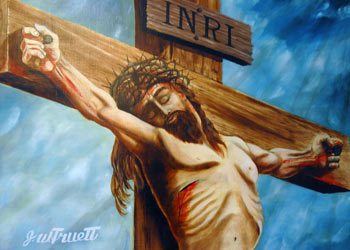
He Cannot Save Himself

Many questions were asked of him,
though no answer was heard.
Pilate pressed him to respond,
but Jesus spoke not a word.

As prophesied by Isaiah,
like a lamb he was silent.
Which angered the crowd even more,
and they began to riot.

Governor Pilate faced the Jews,
and in order to honor custom,
told them that at their choosing,
he would release one prisoner among them.

He knew that Jesus was delivered
out of envy, malice and vice.
But the crowd choose Barabbas,
shouting “Crucify Jesus Christ.”

Pilate washed his hands before them,
saying “I am innocent of this man’s blood.”
The crowd said “Let his blood be upon us,
and upon our sons.”

They stripped off his own garments,
placed on him a robe and crown.
And then pretended to worship,
before him kneeling down.

They placed on his head
a crown made of thorns.
Then they spat, hit and slapped him,
and mocked him to scorn.

They compelled the man Simon
to carry his cross.
And divided his garments,
by casting lots.

They made for him a sign,
placed over his head.
“This is Jesus, King of the
Jews” the words read.

Thieves were crucified with him,
on his left and his right.
One was loud and boastful,
the other more humble, contrite.

“We are guilty of our crimes,
and deserve to die this way.”
And when Jesus saw his faith,
promised paradise that day.

“He cannot save himself” they mocked,
as his blood fell to the ground.
But they were crucifying an innocent,
in whom no guilt was found.

This was God’s plan of salvation,
established before there was time.
Each event had been prophesied,
and now fell perfectly in line.

The trial, the false witness,
his hanging on a tree;
It was all prophesied clearly
in Isaiah fifty-three.

So the words of their mocking
are actually true, you see.
He could not save himself, for
on the cross… he saved me.
Commandments and Traditions, Jesus in Mark 7

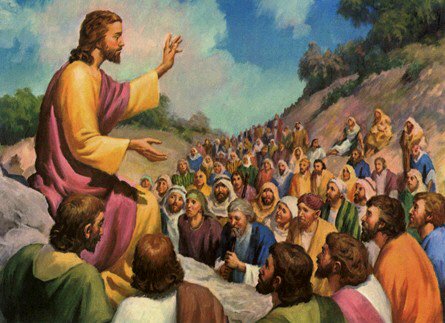
jesus_teachingThis lesson is from Mark 7:1-22.  Jesus is being questioned about why his disciples eat without washing their hands.  Jesus’ response says a lot about first century Jews’ attitudes toward the Old Testament Law, and how they lived out their convictions in real life. 

Jesus’ immediate reply to their criticism is to quote from Isaiah “this people honors me with their lips, but their hearts are far from me.”  Jesus tells them that they ignore God’s commandment to keep the commandment of men.  Continue reading

Jesus on Abraham

abrahamMoses tells the story of Abraham, Paul mentions Abraham several times, but did Jesus ever talk about Abraham?  He does at length in John 8.  Jesus is explaining that God the Father has sent him, yet the people do not listen to his words but instead do the will of their father, the devil.  His Jewish audience insists their father is Abraham.  Jesus says that if Abraham were their father they would do the things Abraham did, such as rejoice when he saw the Day of the Lord.  Jesus contends they are not sons of Abraham. Continue reading
A Thanksgiving Sermon

Tomorrow is Sunday, November 23, and Thanksgiving Day is the following Thursday.  I will be preaching this sermon in the morning, perhaps it will be a blessing to someone here as well.  Anyone may feel free to use this material in a way that brings glory and honor to God.

We are going to begin with 4 scripture readings, used at different times during the service.  You will note that there is one reading each from the Old Testament, New Testament, Psalms and a Gospel.  The final reading is the text of the sermon. Continue reading

The Abbreviated Jesus

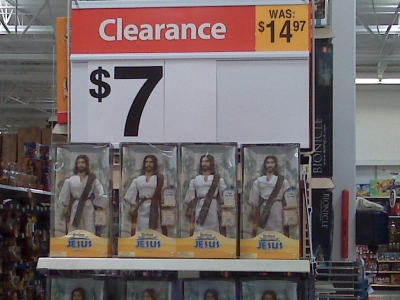
bargainjesusWhen I started this blog, one of the secret little promises I made myself was that it wouldn’t be an Internet Monk fan site.  Listening to his podcast is one of the reasons I started blogging myself.  If you read this blog, you know that from time to time I link other blogs with posts of interest.  Michael Spencer wrote a piece on the “abbreviated Jesus” this week, here’s a snippet that made me laugh out loud:

“The abbreviated Jesus can convincingly seem like the real Jesus, until you look and listen closely. Then it appears that he’s lost his laptop, his luggage and his cell phone. So for right now, he’s reading it all off the teleprompter.”

Read Do You Trust the Abbreviated Jesus?  at internetmonk for the full story.

Old Testament God is the God of the New Testament

angry_godIn a lot of people’s minds, God is this angry, loud, vengeful monster in the Old Testament of the Bible.  Some non-Christians tell us we have two gods, the Old Testament one with the commandments and judgements, and the New Testament one offering grace and mercy.  The God of the Bible is one; he gives commandments, he judges, but also offers to extend grace and mercy instead.  The dichotomy may be apparent, but isn’t a matter of fact. Continue reading

Why I blog in ESV

“The ESV satisfies the preaching, memorizing, studying, and reading needs of our church, from children to adults. We are building all of our future ministry around it.”
John Piper
Pastor for Preaching and Vision, Bethlehem Baptist Church, Minneapolis

I was first introduced to the English Standard Version when I joined the ministry I am presently involved with about five years ago. (see footnotes) The ESV translation is used by our Bible teachers in our classes.  Our campus minister uses it most often when preaching in chapel, but not always.  Since I got mine in 2004, I always teach and preach from it.  I believe the ESV to be the Holy Scripture presented in our modern form of spoken and written English.  It is the Bible.  Continue reading