The Law of Love

Paul has a lot to say in his letters about the Law. Throughout the Book of Romans, the paragraphs have subject headers like “Judgement and the Law,” “Released from the Law,” “Sin and Law” and so on.  As a Pharisee, Paul had studied the Law well and enforced it.  As a Christian sharing the Gospel, he realized that the Law and the Prophets had been fulfilled in Jesus Christ.  His opinion of the Law remained very high.  Paul says the Law is like a tutor, or school master.  It teaches us about the attributes of God.  Living under the Law though would mean we are still subject to God’s judgement.  Living under grace is far superior to meeting the requirements of the Law.  Keeping the Law is a burden we cannot bear.

Paul also has a thing or two to say about love.  I was struck during my last read of Romans at how Paul relates love and the Law together.  Note this passage from Romans 13:

Owe no one anything, except to love each other, for the one who loves another has fulfilled the law.  For the commandments, “You shall not commit adultery, You shall not murder, You shall not steal, You shall not covet,” and any other commandment, are summed up in this word: “You shall love your neighbor as yourself.”  Love does no wrong to a neighbor; therefore love is the fulfilling of the law.  -Rom 13:8-10

Wow.  Love is the fulfilling of the Law; very similar to Jesus’s answer about the greatest commandment in Mark 12.  In that case, Jesus says the greatest commandment is to love God with all your heart, mind and strength and the second is like it, to love your neighbor as yourself.  There is no way to violate any one of the 10 commandments if this love is our guiding principle.  Which is exactly what Paul explains here.  In John 15, Jesus said things like “If you keep my commandments, you will abide in my love,” and even “I give you this commandment, that you love one another as I have loved you.”  I’m still amazed at the way Paul expresses love as the fulfillment of the Law.

Can You Really _______ for Jesus?

This is a promotional video for the Light of the World Ballet Company.  I’ve watched two performances today, and didn’t take a single picture or video.

These are professional performers who tour the world, entering places like India and China that perhaps wouldn’t be open to missionaries (preachers) and share the Gospel while they are there.  Perhaps only Baptists would even second guess ballet as ministry.  Are other denominations as critical of dancing?  “A praying knee and a dancing foot don’t grow on the same leg,” I was told by one preacher’s wife.  Very Baptist.

I told our students (private Christian school) that whatever God has gifted them to do, do that for the glory and honor of God.  How many country music singers learned to sing in church, or got their start in the church choir?  But let me open this box: Can you really do anything for the glory and honor of God? David danced before the Lord; Psalm 150 mentions dancing, blowing horns and crashing symbols.  But where is the line?  Can you skateboard for Jesus?  Bowl for Jesus?  Play in a Christian rock band?  Are there things “done for Jesus” that are really just whatever we wanted to do in the first place?  Can you really (fill in the blank) for Jesus?  Or maybe answer this question: What’s the strangest thing you’ve ever witnessed supposedly done for the glory of God?  I could easily link “preaching baby” again.

The New Thing in Sermons

In the Old Testament, the prophet was a person who did the speaking for God.  Not necessarily predicting future events, the prophet acted as the spoken voice of God on earth.  During Jesus’s earthly ministry, he was found daily in the temple or synagogue reading and teaching.  While his sermon on the mount may have turned the Pharisees’ world upside down, he was regarded as a rabbi in most Jewish circles.  In Acts chapter 2, on the Day of Pentecost, Peter preaches something entirely new. Continue reading →

Memorial Service for Michael Spencer

UPDATE:  Check out internetmonk.com for transcript/ audio of the memorial service.

Services were held this afternoon for the Internet Monk Michael Spencer.  The Internet has abounded this week with articles of tribute and expressions of sympathy for the family.  David Head and Bill Haynes both did excellent jobs.  David has a remarkable understanding of how Spencer’s ministry reaches a worldwide audience through his blog, and Bill did exactly what Michael asked him to; he preached the Gospel. Continue reading →

Bittersweet

My dad often says that his crayon box has only 8 colors.  He was once told the color sample he was holding was pumpkin, not orange.  (He came home from work and asked me what color pumpkins were, just to make his point.)  Children do flavors one at a time.  It starts with baby food – peas, carrots, apple sauce – then extends into not letting their foods touch each other on the plate.  Children also have simple emotions; they like to feel one thing at a time and be able to identify it.  At some point during adolescence, we become aware of mixed emotions.  Sometimes things to be celebrated also make us sad.  We cry at weddings, the birth of a child, and graduation.  We also grieve after the death of a loved one, yet rejoice at the same time during the passing of a Christian. Continue reading →

The “Triumphal” Entry

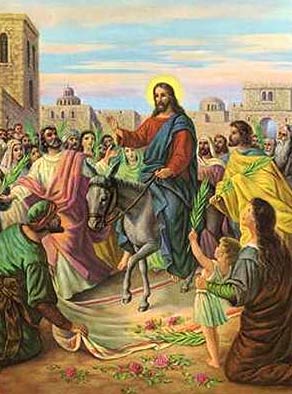
Several well known statements are found in Psalm 118:1-25: “His steadfast love endures forever,” “this is the day the LORD hath made,” “the stone the builders rejected has become the cornerstone,” and even others still.  Verse 25 reads “Save us, we pray, O LORD” in the ESV; “O LORD. we beseech thee, save us now!” in the King James.  The Hebrew word rendered in English as save now is hosanna.

All four Gospels tell the story of Jesus’s triumphal entry.  Palm Sunday is our celebration of Jesus entering Jerusalem for the last time to observe Passover with his disciples. Continue reading →

Who Framed Jesus?

I can tell that Easter is near.  Every year about this time, several television specials and news magazines focus on the fact that Christians still believe in Jesus even though they should not.  In about a week, expect Time Magazine (or its equivalent) to run a cover story on how/why the resurrection could not have possibly taken place.  Predictably, they will claim Jesus either 1) did not die  2) stayed dead, or 3) was never alive in the first place.  Each year, several media outlets predict an end to Christian faith, despite the fact that each year there are still billions of Christians around the world. Continue reading →

Life in Mordor

one does not simply blog into mordor 

Life in Mordor, the Christian blog of Mike Frizzell, has been on my blogroll for a long time.  He left WordPress for a while, went on hiatus, and has now come back home.  Changing hosts (a couple of times) can have a negative impact on a blog, and Mike is in the process of working the kinks out. 

Mike was looking for help, and I jumped at the chance.  The offer still stands if anyone is interested in contributing.  It could involve posting once, occasionally, or daily.  Check out this page  for more info.  You could join The Fellowship (my wife asked if that makes me a troll).  The archive page contains all of his posts listed by category, and also archived by month.  That’s one of those features that gets lost in transition.  The biggest need right now is for a little attention.  Life in Mordor is a work in progress, but it’s progressing nicely.

New Blogroll Friends

His name is Glen, and he’s lovin’ the Lord and livin’ the Life.  That’s actually the slogan of his new blog Men After God.  Mostly what he does is asks pointy questions to get people stirred up and say what they are really thinking. I have a couple of times.   He wants to start some discussions, so drop by and put in your two cents.

Jesus Greater Than Moses: Heb 3

Hebrews is easy to preach because its form is much more like a sermon than an epistle (letter).  At the heart of its message is an impassioned plea not to leave the Christian faith for another, and so in order to be convincing the author of Hebrews makes many comparisons between Christ and all the things of the Old Testament he is superior to.  We have already seen that Christ is superior to the angels, and that through suffering he becomes the perfect founder of our faith.  Chapter 3 begins this way:

Therefore, holy brothers, you who share in a heavenly calling, consider Jesus, the apostle and high priest of our confession,  who was faithful to him who appointed him, just as Moses also was faithful in all God’s house. For Jesus has been counted worthy of more glory than Moses—as much more glory as the builder of a house has more honor than the house itself.  (For every house is built by someone, but the builder of all things is God.)  Now Moses was faithful in all God’s house as a servant, to testify to the things that were to be spoken later,  but Christ is faithful over God’s house as a son. And we are his house if indeed we hold fast our confidence and our boasting in our hope.  Hebrews 3:1-6

Continue reading →