Final Thoughts on Holy Week

jesus_crossThis year for Holy Week I pointed out that Jesus died.  We all know that he was crucified, and was raised to life again, but the real miracle here is that God died.

We asked the question Jesus, sheep or shepherd? That post will be my sermon for Easter Sunday.  I’m preaching twice in the morning.

Another thought was on Jesus’ prayer from the cross.  He didn’t pray just for his followers or his family, but he prayed the prayer of intercession for the people who were crucifying  him.  “Father forgive them, for they know not what they do.”  This is the Christ that we are supposed to be like.

There are some older posts I thought about re-posting, but instead I will just link them here.  He Cannot Save Himself is a poem about the crucifixion.  It is based on the sermon I preached for Easter last year.  Feel free to copy and paste it, print it in your church bulletin, or read it outloud.

Other good topics for Holy Week are Jesus’ Examples: Washing Feet and Passover Becomes the Lord’s Supper.
Thoughts on Holy Week: Jesus’ Prayer from the Cross

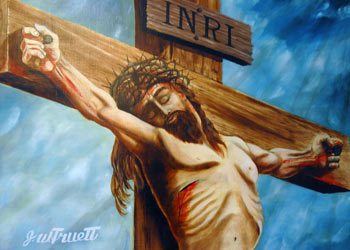
jesus_crossIn his first sermon (Mark 1) Jesus offers a simple message: “Repent and believe the gospel.”  As he hangs on the cross some 3 years later, what is Jesus doing?  We have only a handful of words spoken by Jesus during the crucifixion, but there are some powerful lessons to be shared in them.

As he hangs on the cross, he was in between two thieves.  One of them mocked Jesus, but the other asked to be remembered by him.  Jesus replied that he would be with him in paradise.  Even while dying on the cross, Jesus won a convert!

But even more amazing: Jesus said the prayer of intercession for the very people crucifying him that day. Not just of the Roman soldiers, but for those really responsible, including the Jewish people, the priests and the Sanhedrin.  “Father forgive them, for they know not what they do.”  He prayed for the very people taking his life.  Taking the form of a servant is one thing.  Washing feet is another.  Praying for those that despitefully use you is another entirely.  But none of those compare to asking forgiveness for the very people that are nailing you to a cross, where you will slowly bleed and die.

Jesus, Sheep or Shepherd?

jesus_shepherdThe LORD is my shepherd, I shall not want.

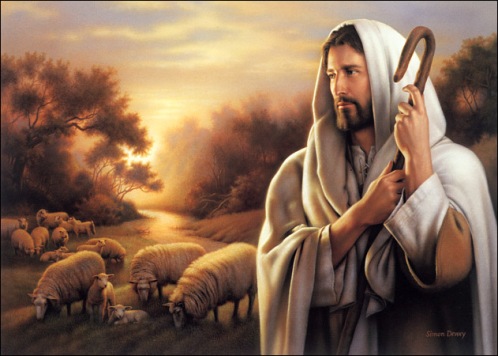
The 23rd Psalm; a very familiar passage and perhaps the most quoted poetry from the Old Testament.  In John 10, Jesus explains that he is the good shepherd.  He is not a hireling, but loves the sheep, and would lay down his life for them.  He has been entrusted by the Father to care for the sheep.  And of course, we’re the sheep.

We’ve all seen pictures of Jesus holding a lamb.   But it’s more than a cute analogy.  Sheep must be cared for.  They have few natural defenses, and are very near sighted.  They need the shepherd.  We too are no match for the devil, often nearsighted (or blind), and desperately need the Good Shepherd.  Continue reading

Thoughts on Holy Week: Jesus Died

jesus_crossI know, perhaps you’re thinking “Well duh.” But give it just a little more thought than that. This is God’s only son we’re talking about here. As a matter of fact, Jesus is God.

On Easter we will celebrate the resurrection. Jesus wasn’t just resurrected, he IS the resurrection. So we’re not simply celebrating the fact that Jesus rose from the dead. He was not the first to rise again. That miracle had happened more than once already. But when Jesus hung on the cross, it was the first time that God had ever died. Two of the gospels recorded Jesus’ birth; all four record the crucifixion. In Matthew’s Gospel, he records the sky going dark until the 9th hour (3 p.m.).  Only Matthew goes on to say that the veil was torn in the temple from top to bottom, and the graves of the saints opened up.  The Old Testament saints went through the street of Jerusalem prophesying (Matt. 27:45, 51-53).  The darkness, the earthquake, the veil, the saints, all highlight an extraordinary event taking place that day.  I’m thinking of a few other scriptures beyond the gospels: Continue reading

Palm Sunday: Jesus’ Triumphal Entry

palm_sunday_UPDATE: this entry is from 2009.  A newer post, with much more information, is this one from 2010.

Palm Sunday is the beginning of Holy Week.  The triumphal entry of Jesus was to be the last time he went up to Jerusalem.  He and his desciples were coming into the city to celebrate Passover.  Thousands of Jews from around Aisa Minor, Africa and Europe were doing the same.  Throughout his ministry, some listeners (among them the Zealots) expected Jesus to claim his throne on earth.  Their idea of Messiah was a military leader, and Jesus was on the scene at the right time if he was going to throw the Romans out of Israel.  Many Jews could hear Messianic things in what Jesus said, and here he was riding into Jerusalem.  The crowd shouted “Hosanna,” and spread palm branches and even their coats along the highway.  Hosanna is sort of like our hallelujah, but literally means save now.   Jesus seemed poised to ride ahead into his greatest victory.

As we move into Holy Week, try to imagine the horror of these first century observers as Jesus was arrested and tried.  What many followers witnessed, including his own 12 apsoltles, was a dramatic turnaround from first to last place.  Some of the same Jews who shouted “Hosanna” would be shouting “Crucify him” by the end of the week.  This is that week.

Ash Wednesday, Lent, (and p.s. Mardi Gras)

ash-wednesday

Ash Wednesday

Ash Wednesday occurs 46 days before Easter, 40 days if you don’t count Sundays.  This year it fell on February 25th.  This marks the beginning of Lent, a time of preparation for Holy Week.  At an Ash Wednesday service, part of the ceremony is placing ashes on the forehead as an outward symbol that you will be observing Lent.  During the 40 day period something is given up, anything typically important to the individual, and more time spent in prayer, worship and meditation.  Lent is about preparing ourselves spiritually to observe Holy Week, the days between Palm Sunday and Easter. Continue reading

“He Cannot Save Himself”

He Cannot Save Himself

Many questions were asked of him,
though no answer was heard.
Pilate pressed him to respond,
but Jesus spoke not a word.

As prophesied by Isaiah,
like a lamb he was silent.
Which angered the crowd even more,
and they began to riot.

Governor Pilate faced the Jews,
and in order to honor custom,
told them that at their choosing,
he would release one prisoner among them.

He knew that Jesus was delivered
out of envy, malice and vice.
But the crowd choose Barabbas,
shouting “Crucify Jesus Christ.”

Pilate washed his hands before them,
saying “I am innocent of this man’s blood.”
The crowd said “Let his blood be upon us,
and upon our sons.”

They stripped off his own garments,
placed on him a robe and crown.
And then pretended to worship,
before him kneeling down.

They placed on his head
a crown made of thorns.
Then they spat, hit and slapped him,
and mocked him to scorn.

They compelled the man Simon
to carry his cross.
And divided his garments,
by casting lots.

They made for him a sign,
placed over his head.
“This is Jesus, King of the
Jews” the words read.

Thieves were crucified with him,
on his left and his right.
One was loud and boastful,
the other more humble, contrite.

“We are guilty of our crimes,
and deserve to die this way.”
And when Jesus saw his faith,
promised paradise that day.

“He cannot save himself” they mocked,
as his blood fell to the ground.
But they were crucifying an innocent,
in whom no guilt was found.

This was God’s plan of salvation,
established before there was time.
Each event had been prophesied,
and now fell perfectly in line.

The trial, the false witness,
his hanging on a tree;
It was all prophesied clearly
in Isaiah fifty-three.

So the words of their mocking
are actually true, you see.
He could not save himself, for
on the cross… he saved me.

Passover Becomes the Lord’s Supper

When Jesus instituted the Lord’s Supper, he was taking an ancient Hebrew tradition and giving it new meaning.  (Matt. 26) For the followers of Jesus, taking communion reminds us that Jesus’ body was broken and his blood shed just like Passover reminded the Jews that the death angel passed over Egypt.  Jesus is the Lamb of God that was slain, much like the sacrificial lamb was slain in the Old Testament; the difference is that Jesus was the perfect sacrifice so that no more is needed. (Heb. 9)

If you listen to this sermon, remember that I’m speaking to middle and high school students.  LOTS of backstory and explanation is given, and I am well aware that I often repeat myself.  I believe the message is the truth of God’s Word, and the Gospel is clearly presented.  Click here to listen (mp3)

Jesus’s Example: Washing Feet

“For I have given you an example, that you also should do just as I have done to you.”

The above scripture is John 13:15. I am going to start a new category of blog posts called Jesus’s Example. The first one is going to be Jesus washing the disciples feet, as recorded in John 13. It’s one of those Holy Week events that I just didn’t have time to squeeze in. All scriptures are taken from the English Standard Version (ESV).

This particular lesson took place before the Passover was observed. Jesus and his disciples were gathered together, and had eaten supper. Jesus then takes off his outer robe, ties a towel around his waist, and begins washing the disciples feet. Washing feet was a normal part of first century culture. If you’ve ever worn sandals on the beach, or even just around your house in the summer, you know that feet get dirty quickly. Not just dirty, but ground into the skin, hard to scrub off dirt. Ordinarily it was the servants who washed the feet of your guest if you were hosting an event. There were people who washed feet, that part of the story shouldn’t be surprising. Keep the culture of the time period in mind. But Jesus was the disciples master, their rabbi. It was not his place to wash feet. Beginning in verse 12, he begins to teach his lesson. “Do you understand what I have done to you? You call me Teacher and Lord, and you are right, for so I am. If I then, your Lord and Teacher, have washed your feet, you also ought to wash one another’s feet. For I have given you an example, that you also would do just as I have done to you. Truly, truly, I say to you, a servant is not greater than his master, nor is a messenger greater than the one who sent him. If you know these things, blessed are you if you do them.”

Jesus had already humbled himself by leaving Heaven and taking on the likeness of man. Philippians tells us that he did not think equality with God a thing to be grasped, and was obedient even to the point of death on a cross. Washing their feet, though, was a solid, concrete, tangible illustration that the disciples could see and feel. He was their leader, and also humble servant. If we follow Christ’s example, their isn’t much that we are too good to do. I’ve mentioned this briefly before. It’s hard to make excuses with Jesus standing there saying “You know, I washed feet.” The Apostle Paul testified before heads of state, and after being imprisoned was an ambassador in chains. Any one of us would accept an invitation to the governor’s mansion, but would we accept as quickly the invitation to a trailer park? Are there people you don’t invite to church because you’re afraid they would actually come? We are instructed in scripture not to think too highly of ourselves, and given an example by Jesus that’s hard to ignore. Jesus talked to Samarian women, whores, lepers, tax collectors, and even one of the thieves hanging by him on the cross. By his own admission, he was a criminal that deserved his punishment. But Jesus told him he would spend that day with him in paradise. Is there a job in the church we’re too good to take, or a person in need of Christ that we’re better than? Not if we follow Jesus’s example.

He cannot save himself.

So also the chief priests, with the scribes and elders, mocked him, saying, “He saved others; he cannot save himself. He is the King of Israel; let him come down now from the cross and we will believe him. Matthew 27:41-42 (ESV)

As Jesus hung on the cross, obedient to the Father’s will even to the point of death, the crowds and the accusers still mocked him. Matthew goes on to say that the thieves acted this same way. In Luke’s account, one of them even says to him “Are you not the Christ? Save yourself, and us.” I am drawn to that statement “He cannot save himself.” Yes, he could.

The night before, in the Garden of Gethsemane, Jesus prayed to God the Father. He knew what lie ahead, and he wrestled through blood, sweat and tears as he prayed. Even while he was tempted not to go forward with God’s plan (being tempted is not a sin) he prayed for the Father’s will to be done. Jesus could have saved himself that night, by not waiting for the guards to come and arrest him. He had foretold that Judas would betray him. Jesus knew when and where, and awaited the arrival of the Roman soldiers and his betrayer. He had escaped angry mobs before, but did not this time. Not because he could not, because God did not will it.

At the beginning of his ministry, Jesus was tempted by Satan. In all three instances, what was being offered was an easy way out. Jesus had been fasting, so in his hunger he was tempted to turn stone into bread. He responded with scripture. He was tempted to throw himself from a high place, and thus summon legions of angels. He again quoted scripture, responding with God’s truth. Satan offered Jesus the kingdoms of this world if he would fall down and worship him. All three cases were the easy way out. If he would just accept Satan’s offer, he could reign right now, not years later after hard work and death on the cross. He was offered a short cut, not the long, slow plan that God had designed. He was offered instant gratification, a temptation we Americans know all too well. Jesus, however, took the long, slow, hard way that God had designed to bring salvation to mankind. Remember when Peter drew his sword in the garden, cutting off one man’s ear? Jesus response to “Get behind me Satan!” makes sense when you think about how Peter was offering an easy way out. That was what Satan had offered three times. Taking up the sword, battling their way out of the garden, Jesus could have saved himself. But that was not what he came to do. He came to die.

Jesus could have saved himself and come down from the cross – but it would have cost the lives of every Christian believer that has been since. The Bible clearly teaches that he came into the world to save sinners. He was offering himself as a sacrifice. He came to save us, not himself. He plainly states that no one can take his life, but that he gives it freely. His life was the ransom for many, the price of our redemption. Those same accusers that mocked him with “He cannot save himself,” Jesus was dying to save. He prayed a prayer of intersession for the very people crucifying him that day. “Father forgive them, for they know not what they do.” Christ led by example; he didn’t just tell us to love our enemies, and pray for those who use us. He did it himself with his dying breath.

I can’t stand to be mocked. I’m one of those people that has to always prove that I am right. Jesus example on the cross only illustrates how far each of us fall short of righteousness. He perfectly lived out the commands to love others, to think more of others than of self, to pray for those who use, and to bless those that curse. I could never have been that righteous in those circumstances I’m sure. None of us could. It’s a good thing we don’t have to; Christ did it for us. He is our righteousness.