Book Review: Revival and Revialism

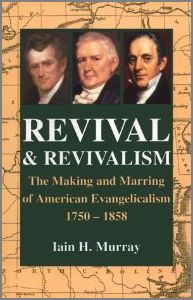
Michael Spencer was the first person I heard use the word revivalism.  Any type of -ism refers to the belief in or practice of a particular thing.  Some churches live in a revival subculture, where revival meetings, revival services and revival preachers are a regular part of ministry.  I believe Iain Murray has written a book after Spencer’s own heart.

I just read an excellent review of Revival and Revivalism: The Making and Marring of American Evangelicalism, 1750-1858 at the 9Marks blog.  Bobby Jamieson has spent some time with the text; the review is practically a study guide to the actual volume.  Read the full review here.

*The review lists $33 as the price, which is retail.  Amazon has it for $24.09, if you’re interested.

From the Archives: Jesus Was Not Religious

During his lifetime Jesus was an observant Jew.  But doing more and more religious things is not the same as living a life that is being transformed into the image of Christ.  The following was originally published June 22, 2009.

I’ve said before that the problem with religion is that it’s easier than following Jesus.  It is usually a given that something is wrong with us, wrong with the world, perhaps critically or else just a little off, but most people agree that something must be done because all is not right in the world as it is.  Religion, in most cases, offers us the chance to do something.  If we read the right book, say the right things, act right, talk right and treat each others the right way we can “fix” what is wrong.  Religion, as such, is worthless.  But what could I mean that Jesus was not religious?

The religious leaders of his day were the Pharisees, and a careful reading of the Gospels shows that Jesus never really had much good to say about them.  He was always willing to share with anyone seeking to understand the truth (i.e. Nicodemus), but as a group Jesus was most likely to call them hypocrites, false teachers, spiritually blind, and sometimes worse.  Continue reading

Will the real RM-2493 Please Stand Up?

Have you ever seen (or signed) one of those petitions supporting public broadcast of religious programs?  I remember hearing as early as 1993 that Madalyn O’Hair, infamous for getting prayer removed from public schools, was engaged in petitioning the FCC to ban all religious programming from radio and television.  Resolution Number 2493 has generated heated dispute for over 35 years.

Today you might get an email or see a Facebook message claiming Dr. James Dobson (or some other Christian leader) is pleading with American Christians to sign a petition or write the FCC.  Dobson denies any involvement with such requests.  Other preachers or ministries are sometimes listed as being in danger, and some versions are geared toward Christmas.  2493 would supposedly ban all Christmas programs and carols from public schools.  Please don’t sign the petition, don’t forward it to anyone, and certainly DO NOT write a letter to the FCC.  They have been inundated with thousands of pieces of mail for over 35 years for no good reason whatsoever.

The real RM-2493 was presented to the FCC in 1974 and denied in 1975.  The real document was not sponsored nor endorsed by O’Hair in any way.  It requested the FCC not give religious organizations licences to broadcast on channels reserved for education.  Again, the resolution was denied by the FCC in 1975, but even at that time they responded to the thousands of letter received from misinformed citizens.  The FCC clearly understood their role as an agency of the federal government was to neither promote nor inhibit religion.

RM-2493 did not call for a ban on religious programming on the airwaves.  The resolution was denied in 1975.  The FCC does not have the authority to ban religious programming even if it wanted to.  Further, Madalyn O’Hair has been dead since 1995.  Yet the rumor lives on.  The FCC has received over 10 million letters, email and phone calls.

More at snopes.com

Can a Christian …

Can a person be a Christian and _________?  We’ve all heard that or wrestled with it at one time or another.  We may  be tempted at times to wish for a simple list of 80 gazillion rules that spell out every possible situation, leaving no grey areas to deal with.  That’s basically what they had in the Old Testament and that didn’t work out either.  There are so many issues the Bible either doesn’t speak to or doesn’t address as clearly as we would like.  Can a Christian drink?  What about smoking?  Can I be a Christian and still get a tattoo/play cards/dance/listen to pop, rap and/or country music?

The Bible may seem at times to give conflicting instruction.  We are to walk circumspectly of the world, and to not love the world or the things the world loves.  Paul makes cryptic statements like “all things are lawful for me but not all things are profitable.”  That’s the law of grace, but… what?  Can I play Texas Hold’em or not?

Dave Miller at SBC Voices does an awesome job with this.  He divides most issues up into four categories, and rather than attempt to answer each question he guides the individual to set up a rubric of sorts to work them out.  I found this post in particular very well written and extremely helpful.  He links to many other posts in the series.  Highly recommended.

What Christians Are Looking For in a Church

Shaun King resigned earlier this month from Courageous Church in Atlanta.  Internet Monk has all the details here.  In short, he realized after loosing a lot of members in his attempt to build disciples that what his congregation really wanted was the Sunday morning show.  This got me thinking about what most Christians are looking for in a church.

King had followed all the advice given to him about building a congregation when starting a church.  He now says that he sold his soul for attendance and never quite felt like he was able to get it back.  He began preaching sermons and taking steps to get Courageous Church away from it’s Sunday morning focus and make the shift toward small groups, building disciples, and engaging the community.  He lost 85% of his membership.   Continue reading

In God We Trust: Let’s Be Honest

Quick thought: I heard a preacher this morning say that “In God We Trust” is printed on all our money, and that must really tick God off.

I’ve wondered before how much longer that was going to last.  In all honesty I can’t believe our printed bills and minted coins still I have that on them.  Some ridiculous things have occurred in the name of separation of church and state.  We don’t live in a theocracy, but in a free country, and I understand that well.  Michael Spencer said that mixing church and state is kind of like mixing dog crap with ice cream; you can’t make the crap any better but it sure does ruin your ice cream!

What do you think: Is it to our credit that our money bears “In God We Trust” or is it just a lie?  Remember, this is our money we’re talking about.  We know what Americans really trust.

Life in Mordor, My “Other” Other Blog

I blog religion and theology on this site, The Master’s Table.  My Other Blog is filled with YouTube clips, funny pictures and random entries on life, sports, television shows I’m watching and the weather.  (Everybody blogs about the weather…)

I occasionally join Mike F. and Joe Derbes in a group project titled Life in Mordor.  My latest contribution is The Gospel According to Allegory.  Check out some Mike and Joe stuff while you’re there; comments and link love would be greatly appreciated.

Every Saga has a Beginning

Today is Easter Sunday.  Lent bagan 40 days ago, Palm Sunday was last week, 2 days ago was Good Friday.  Holy Week is about the end of Jesus’ ministry on earth.  Not too long ago – it’s been about 4 months – we celebrated the beginning of his life on earth.  Do you remember that story?

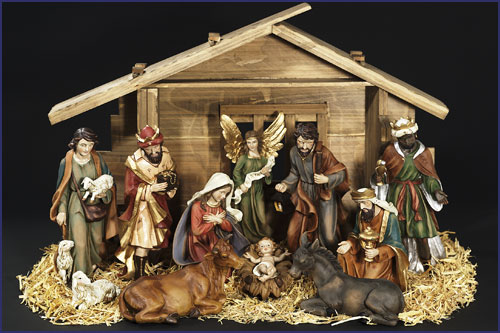
Joseph and Mary traveled to Bethlehem, to be counted in the Roman census and taxed.  Baby Jesus was laid in a manger, shepherds came and worshiped, and the wise men traveled from afar.  They followed the star and brought gifts fit for a king.  Jesus was presented with gold, frankincense and myrrh.  Gold makes sense; no one would mind getting that present.  Frankincense is an incense, a sweet perfume.  It’s actually a resin, made from the bark of a tree.  Myrrh is very similar, but bitter.  It’s most common use in the first century was anointing the dead.  Gold is an awesome gift, perfume maybe, but… you wouldn’t give a newborn embalming fluid.

Once you know how the story ends, the beginning makes more sense.  In literature, it’s called foreshadowing.  Jesus was born to die.  He came to be a sacrifice.  The unusual gift brought by one very wise man reminds us what is really important about Christmas.  The gifts that were given to Jesus pale in comparison to the gift of Jesus.  Throughout his ministry Jesus understood his mission, even when his followers could not.  The disciples were told plainly that the Son of Man must suffer many things, be rejected by men, even that he must die.  Jesus told them, more than once, that he would rise again.  Eventually they were afraid to ask.

The real story of course begins before the incarnation and does not end with the crucifixion.  Today is Easter, the celebration of Jesus’ resurrection.  That still isn’t the end of the story.  Jesus wasn’t just resurrected; he is the resurrection.  The story of God’s coming kingdom isn’t over yet.
Weather, Economy, and the Apocalypse

The price of gas has passed $4 in many places, and some are predicting $5 across the country by Memorial Day.  The Consumer Price Index has risen 2.7% just this year.  Thunderstorms and tornadoes are occurring with incredible frequency in the United States, and it’s hard to miss the global increase in earthquake, tsunami and volcano activity.  So am I ready to predict the end of the world?  I suggest not starting an office pool.

The Apostle Paul expected the return of Christ in his lifetime.  You can almost feel a change in his attitude by the time of his final letters.  There is a noticeable “policy shift” if you know what to look for.  Throughout the ages people have predicted the day and date for the end of the world.  Statistically they have been wrong 100% of the time.  Are wars in the Middle East and earthquakes a sign the end is near?  Yes.  But in a greater sense, the end is always near.  The return of Jesus Christ is imminent; that means nothing else has to happen before his return takes place.  That doesn’t mean it will be this weekend – or this decade – however.  If I board a non-stop flight in Atlanta, then my arrival in (your favorite city here) is imminent.  The plane will not be landing anywhere else first.  The next stop will be at our destination.  What we know for certain by reading the scriptures is that Jesus’ return will come like a thief in the night.  What we know for certain is that we cannot know for certain when it will be.

Things will get worse before they get better.  Ralph Sexton Jr. predicted in the late 70’s that the price of a loaf of bread would be over $1.  People laughed.  When Israel became a nation in 1947 that was as good as handwriting on the wall for many Christians.  Yet Jesus did not return the next day.  Mikel Gorbachev turned out not to be the anti-Christ.  The 91′ Gulf War was not the beginning of Armageddon.   The collapse of the Soviet Union meant that it was neither Gog nor Magog (though not everyone agrees).

Today there are earthquakes and storms.  There are wars and rumors of war.  The end is near.  And if Christ tarries his coming another hundred years – or thousand – the end will near then too.  Don’t go around saying stuff that will make all Christians look silly this time next year.  Love your kids, read your Bible, share the Gospel – and go on with your life.  I wouldn’t recommend selling your house just yet.

Where is God?

Where is God? Lots of people have a take on where God might be. Atheists believe that there is no god of any kind, anywhere. Agnostics believe there may be a god or some type of higher power, but we either don’t know what that is or perhaps we cannot know. Deists believe the universe was set into motion like the gears of a clock, but that we are tiny and insignificant to such an omnipotent God. Then there’s New Agers, Scientologists, Oprah and so forth. Some spend their entire lives looking for God, but he isn’t hard to find. The truth is it should be hard to miss God. Continue reading