So also the chief priests, with the scribes and elders, mocked him, saying, “He saved others; he cannot save himself. He is the King of Israel; let him come down now from the cross and we will believe him.” Matthew 27:41-42 (ESV)
It has been a few years since I shared this poem. Attached is the live reading I did at Unity Baptist on Palm Sunday, April 13th.
A few years ago I wrote a series of posts on what I consider academic discussions. The discussion and debate over Calvinism is, ultimately, academic. It is hotly debated only by people that are already saved. No one shares the gospel by saying “if you are of the elect then God has chosen you and will give you the faith to be saved.” Only after being saved do we debate whether we chose God or God chose us, and to what degree we had anything to do with it. The unsaved need to hear the gospel and ideally they would not hear Christians argue over Calvinism or any other doctrine. That needs to be an internal discussion. Another example is the age of the earth. I refuse to argue this issue because ultimately there is no way to know who is right and wrong and it doesn’t make any difference. If Jim believes the earth is 6,000 years old and Amy believes the earth is 4.5 billion years old, all that really matters is whether they believe Jesus was dead and made alive again for our justification. We could host a debate, make the respective cases and even have a panel of judges determine who wins. But the outcome of the debate would have no bearing on when or how God created the world. There would be no impact on how I love my wife, raise our child or treat my neighbor. There is no meaningful application.
I am preaching through the book of Romans at Unity Baptist Church. As an aside let me say this: there is a long list of links in the RSS feed in the left-hand sidebar from our church website. The number of links to display is set at three (3) and always has been. One day it just started showing 10. I checked to see if the settings had changed and they had not. I changed the number to 10, updated my settings, went back into the design editor, changed it to three… and it still displays 10 posts, the maximum number allowed. At any rate, I am seven sermons into the Romans series and all of them are linked to the left of this post.
I have written before on the fact that denominations exist and suggested that Luke 9:49-50 may apply. The church exists all over the world and without being worldly minded people are products of their culture. There are many different flavors of Christianity and what one must believe to be saved is that Jesus is the Son of God, died for our sins and God raised him from the dead. Everything else is details; there may be important details but the facts listed in the previous sentence is what all Christians must agree on.
So the question has been raised regarding different positions on theology. There are Calvinists, Arminians, and those that claim neither position but believe all we need is the Bible. There are Christians that believe we should worship on the Sabbath and others that gather on what they call the Lord’s Day. There are three basic positions on when the rapture will take place, other sub-divisions, and those who do not believe there will be a rapture. There is so much disagreement that one must either conclude there Is no God or that he offers us much grace otherwise no one gets credit for doing everything correctly. Who is right, who is wrong, and more importantly how can we know?
I hate taking an extreme all or nothing position on anything. Jesus Christ is the way, the truth and the life. That’s just about the only total extreme I’m willing to stand by. Polarization on just about every other issue does more harm than good.
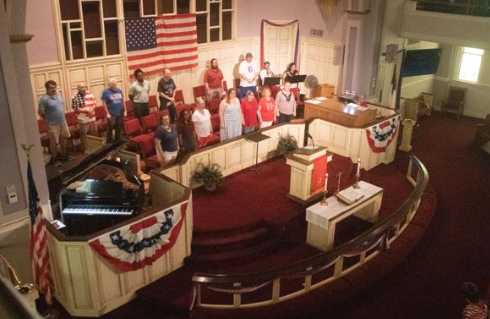
I read a tweet on Sunday afternoon that said if your church service is 4th of July themed that’s idolatry. I’m sorry I don’t know who posted it. I did not save it because I had no idea I would be coming back to it but now I can’t shake it. Anything can be taken to an unhealthy extreme. It is common for believers in our culture to get their strong feelings about Christianity and America mixed together. The image of a cross decorated with stars and stripes makes me a little twitchy. I can hear Michael Spencer screaming in my head. But just about every church I’ve ever been a part of has an American flag, and usually a Christian flag, in the sanctuary. Some would claim that displaying a flag in church or pledging allegiance to the flag – anywhere – is not something Christians can not do with a clear conscience. Our pledge and oath should be to Christ and no other. That is extreme at the other end of the spectrum. As is true with most things I’m more comfortable somewhere in the middle that at either far end.
Sometimes I see images like this on Facebook or wander into discussions/arguments and can’t believe we are still at odds over food laws. The early Christians in the first century couldn’t come to a consensus so it should surprise no one that all of us do not agree today.
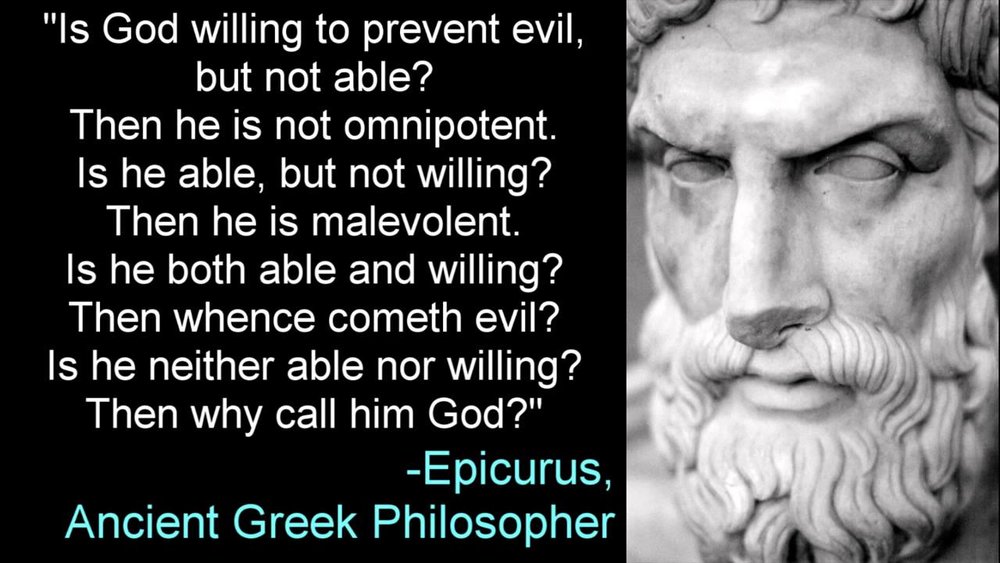
I don’t want to explore the problem of evil. I want to use that question and the arguments made by atheists and agnostics to discuss how we use our resources to analyze and respond to such questions. 1 Peter 3:15 is the basis for Christian apologetics: always being prepared to make a defense to anyone who asks you for a reason for the hope that is in you; yet do it with gentleness and respect…
When I was college I took an honors level class simply titled Critical Thinking. I think it should have been required of all entering freshmen; definitely wished our debate team in high school could have spent a few weeks each year in that course. I didn’t go to a large state funded university that spent four years trying educate the faith out of us or teach me that everything my parents ever believed was wrong. At a private liberal arts college, affiliated with the Georgia Baptist Convention, the professor wanted us to think things through, use logic and empirical data, in order to defend whatever position we claimed. He was not an atheist trying to turn us against the Christian faith, as some have claimed when I share this story. He posed us this dilemma so that, like iron sharpens iron, we could work through a proper response: God is either all powerful or all good but cannot be both. If he is all good then evil exists because is unable to eliminate it. Conversely if God is all powerful then he must be evil as he chooses not to do away with it. Discussion ensued.
First things first: The image above is a tweet. The current limit on characters is 280 and while that can be useful one cannot fully express the balance of a lifetime of study in a couple of sentences. Benjamin Cremer is a Wesleyan pastor with multiple degrees including a Master’s in Theological Studies. To learn more about Rev. Cremer and his views read more tweets; and he also writes books. I want to use the tweet as a launching point to make a deep dive into what we understand from scripture about God’s judgement. My post of 600 to 800 words will still fall short of everything the Bible has to say.
The post Time and Eternity was my attempt at concisely putting together some ideas that kind of spiraled out of control when I preached them from the pulpit. I wanted to outline the main points, support with scripture, and come as immediately as I could to a conclusion. I am pleased with the way it turned out, except for later realizing I had left out what could be an important consideration.
I was accused a few years ago of being in a cult of Paul. The assertion was that myself and others made too much of the Apostle Paul, his writings and his particular brand of New Testament theology. We needed to be less Paul-focused and more Christ-focused. I argued that Paul was Christ focused and studying Paul should bring Christ into focus. Paul pushed back on some of those same accusations during his ministry stating the Christ is not divided and there are not Paul Christians, Apollos Christians, etc. Here is a link to my first Defense of the Apostle Paul from eight years ago. The comment thread was very involved, and might be longer than the actual post.





 The Master's Table