 It is important to remember what we have. There is an old saying that you don’t know what you have ’till it’s gone. I hope that’s not always true. I’ve known people that were getting ready to sell a car, and wanted it to look it’s best to fetch the best price they could get. After vacuuming and cleaning the interior, washing and waxing the finish, ArmorAlling the tires, etc. they decided to keep the car. Sometimes it’s tough to recognize what we are in possession of, but it’s more important for Christians to be able to than anyone else. Continue reading
Category Archives: Theology
After my own heart…
God describes David as being a man after his own heart. I found one of those tonight. Thanks to internetmonk (this isn’t just a fan site) for turning me on to Ray Ortland, over at Christ is Deeper Still. Consider this quote:
“What unifies the church is the gospel. What defines the gospel is the Bible. What interprets the Bible correctly is a hermeneutic centered on Jesus Christ crucified,”
That’s almost something I would write, only it says more in fewer words. If you want to be a good writer, read people that are better than you.
Passover Becomes the Lord’s Supper
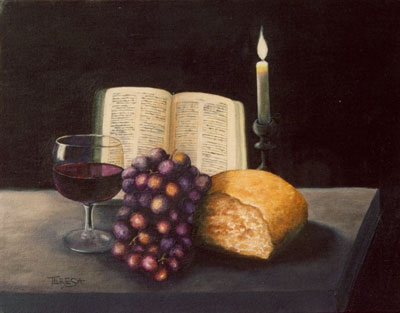 When Jesus instituted the Lord’s Supper, he was taking an ancient Hebrew tradition and giving it new meaning. (Matt. 26) For the followers of Jesus, taking communion reminds us that Jesus’ body was broken and his blood shed just like Passover reminded the Jews that the death angel passed over Egypt. Jesus is the Lamb of God that was slain, much like the sacrificial lamb was slain in the Old Testament; the difference is that Jesus was the perfect sacrifice so that no more is needed. (Heb. 9)
If you listen to this sermon, remember that I’m speaking to middle and high school students. LOTS of backstory and explanation is given, and I am well aware that I often repeat myself. I believe the message is the truth of God’s Word, and the Gospel is clearly presented. Click here to listen (mp3)
Ever feel like you’re alone?
 Elijah is one of the better known prophets of the Old Testament. Just after defeating the prophets of Baal, however, Elijah does something very strange considering his victory. He hides out in a cave and simply asks God to kill him. 1 Kings chapter 19 is the very well known passage where there is a wind, but God was not in the wind; there was an earthquake, but God was not in the earthquake. Finally he hears the voice of God in a small still voice. I’m sure you’ve at least heard of this story. But twice in this passage Elijah expresses his concern that he is the only true believer left in the world. God basically tells him to get over his pity party, and informs him that there are 7,000 still in Israel that never bowed the knee to Baal. The lesson for us is that we are often not as alone as we think.
In Genesis chapter 14, Abram is the only man of faith we know about. After the flood, the population of the world grew, and very quickly forgot about God. As far as we know, Abram is the only person God is talking to period. Then he meets Melchizadek, king of Salem and priest of God Most High (El Elyon in Hebrew). Melchizadek blesses Abram, and Abram gives the priest a tenth of all he has. What’s weird about all this is the tribe of Levi, from which the Levitical priests are anointed, will not exist for hundreds of years yet. Levi was Abraham’s great-grandson, but not yet, not in Genesis 14. The New Testament book of Hebrews makes a big deal of this, and has a lot to say about the relationship between Abraham the patriarch and this priest not of the Levite order. Simply put, Abram was not alone in his belief of the True and the Living God.
At times, we are placed in tough places to grow. Remember the sunflower story? It can be discouraging, but recall the words of Jesus in Matthew 28: “I am with you always, even until the end of the age.” Just before that he said all authority was given to him in heaven and on earth. Not only are we not alone, who better could we ask be with us?
Here is this sermon in mp3: abraham-and-melchizadek
Do you know my King?
The narrator is S.M. Lockridge. There is a dedication at the end.
Lessons from the Garden of Eden
 7 then the Lord God formed the man of dust from the ground and breathed into his nostrils the breath of life, and the man became a living creature. 8 And the Lord God planted a garden in Eden, in the east, and there he put the man whom he had formed. 9 And out of the ground the Lord God made to spring up every tree that is pleasant to the sight and good for food. The tree of life was in the midst of the garden, and the tree of the knowledge of good and evil. -Gen. 2:7-9
Lesson 1: We are special to God. Human beings are made in God’s image and likeness (Gen 1:26-27). What does that mean exactly? I’m not even sure. People will tell you what it means, but truthfully, we don’t really know for sure. We do that no other being in creation is described this way. Continue reading
Christ Centered Preaching
I’ve thought some more on what Christ centered means, and wish I could say this to every preacher everywhere: Preach the gospel. Are you preaching on the Law being given to Moses? Great; just make sure to mention how Christ fulfills the Law and the Prophets, and perhaps include Paul’s statement that the Law is like a tutor to him. Teaching from Job? Be sure to include “I know my Redeemer lives,” before you’re finished. The story of how God deals with fallen man is the central thematic element that runs through the entire Bible. Continue reading
God honoring, Christ centered
I don’t know how well that shows up on your screen in the banner. Is that just a slogan? Well, sort of. When creating a wordpress page, you’re asked to write a title, and then a brief description of what your blog is about. “God honoring, Christ centered” is there as much as anything to remind me what I’m doing here. What does it mean? Now that my friend is the right question. Continue reading
Leaps of Faith
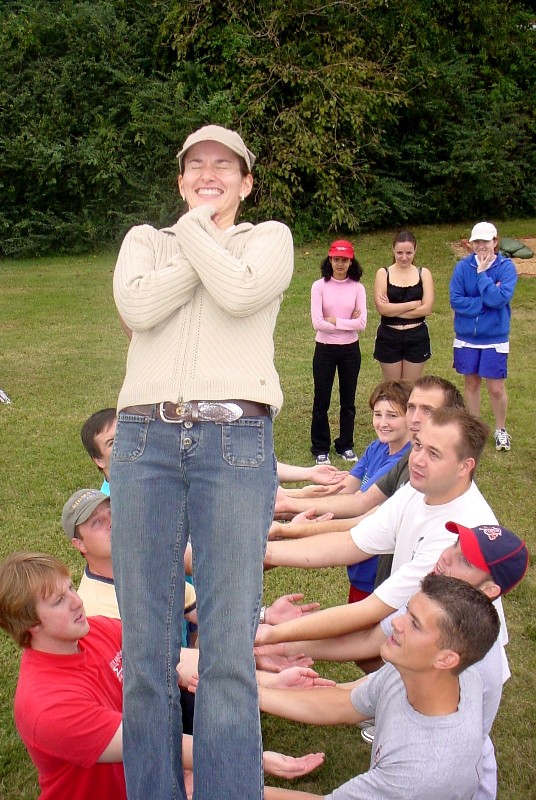 Remember those team-building seminars that had you fall backwards into the arms of your co-workers? That trust fall activity was about building trust and forming community, etc. The video below is something like that, but a lot more fun to laugh at.
Let me give you all the background first. In the Sunday a.m. service, I preach a straightforward, classic sermon on faith. Genesis 15 and Luke 8 were used as the main texts, and other examples from the Old and New Testaments were illustrated briefly. In the first text, Abram’s faith was counted to him as righteousness, and the second is the story of the woman with the issue of blood for twelve years. I explained that faith was more than believing, it was about trust. Faith causes us to act. In the Sunday evening service, I read the many examples of how people of faith took action found in Hebrews 11. Then we did the fun stuff.
Each of the volunteers was taken out of the room and kept in isolation, being brought back in one at a time. What they were told was that after being blindfolded, we would be raising them up 5 or 6 feet, and asking them to jump. I told each to have faith that we would be providing for their safety, and they wouldn’t get hurt if they took the leap of faith. In reality, they were never more than about 6 inches off the floor. They could feel the sensation of movement, while at the same time I’m kneeling down. In all the times I’ve done this, I’ve never had a kid not jump. Most fall (as do our 3 people of faith in the video), since they expect to drop several feet to the floor.
The Biblical Exegesis of a Renowned Atheist
 “Christians seldom realize that much of the moral consideration for others which is apparently promoted by both the Old and New Testaments, was originally intended to apply only to a narrow defined in-group. ‘Love thy neighbor’ didn’t mean what we now think it means. It meant only ‘Love another Jew.'” -Richard Dawkins
You see friends, what you have here is one of the world’s foremost anti-theists, what Becky Garrison describes in her book as “the new atheists.” Richard Dawkins not only believes there is no God, he thinks religious faith is dangerous and a threat to our society. Continue reading
 The Master's Table