The Lord’s Prayers

Reblogged from April 1, 2012. Originally Holy Week: Three Prayers of Jesus 
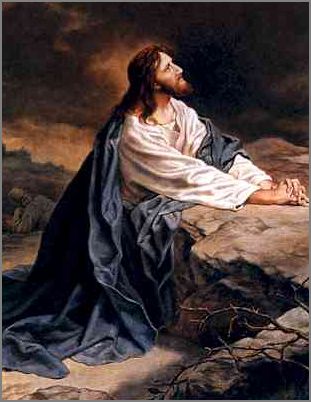
When Jesus taught his followers how to pray, he gave them a simple formula (such as in Matthew 6).  We often called this the Lord’s Prayer, but Model Prayer or even Disciples’ Prayer would be more descriptive.  Here are three prayers Jesus himself prayed during Holy Week.

The High Priestly Prayer (John 17) This entire chapter is a prayer spoken by Jesus that we call the High Priestly Prayer.  The writer of Hebrews goes to great lengths to detail the ways Jesus acts as our high priest, continuously going into God’s presence and making intercession on our behalf.  His prayer in John 17 casts Jesus in the role of High Priest, bridging the gap between man and God, between the unholy and Most Holy.  Jesus has only a few days left on earth at this point in the story, and is about to take his place at God’s right hand.  Jesus prayed for his followers of that day and all that would ever believe and follow in the future.  Jesus literally prayed to God for us. Continue reading →

Prophetic Words – Part 2

Gamaliel's CouncilWhen they heard this, they were enraged and wanted to kill them. But a Pharisee in the council named Gamaliel, a teacher of the law held in honor by all the people, stood up and gave orders to put the men outside for a little while. And he said to them, “Men of Israel, take care what you are about to do with these men. For before these days Theudas rose up, claiming to be somebody, and a number of men, about four hundred, joined him. He was killed, and all who followed him were dispersed and came to nothing. After him Judas the Galilean rose up in the days of the census and drew away some of the people after him. He too perished, and all who followed him were scattered. So in the present case I tell you, keep away from these men and let them alone, for if this plan or this undertaking is of man, it will fail; but if it is of God, you will not be able to overthrow them. You might even be found opposing God!” So they took his advice. (Acts 5:33-39)

Continue reading →

Prophetic Words – Part 1

CaiaphasAs Abraham was on his way to sacrifice Isaac, the boy made an observation: they had fire and wood, but no lamb to sacrifice. Abraham replied “God will provide himself a lamb.” That day he offered up a ram caught by his horns in a thicket, but we can see something of a prophesy in Abraham’s words: “God will provide himself with a lamb.” Abraham could not have been speaking, at least in his own wisdom, of the Lamb of God that takes away the sin of the world. But we get it. Now consider these words of Caiaphas: Continue reading →

Whose Side Are You On?

When Joshua was by Jericho, he lifted up his eyes and looked, and behold, a man was standing before him with his drawn sword in his hand. And Joshua went to him and said to him, “Are you for us, or for our adversaries?” And he said, “No; but I am the commander of the army of the LORD. Now I have come.” And Joshua fell on his face to the earth and worshiped and said to him, “What does my lord say to his servant?”
(Joshua 5:13-14 ESV)

First, notice that the angel Joshua encounters is not a beautiful woman in a choir robe. Armor-clad soldiers is one of the things History’s The Bible got right.

Secondly, notice he doesn’t say he is on Joshua’s side. He is the commander of the army of the LORD, and Joshua is his servant. Where do we get the idea that God is ever on our side? We don’t even have a side. If you recall, it is later Joshua who says to the nation of Israel “Chose this day whom you will serve… But as for me and my house we will serve the LORD.”

The New ESV Bible .org

The English Standard Version of the Bible from Crossway Publishers has been and continues to be my translation of choice. All scripture references on this website (that have links attached to them) link to the ESVBible.org website and if you have a habit of following those you will notice a change. Continue reading →

Happy Monday

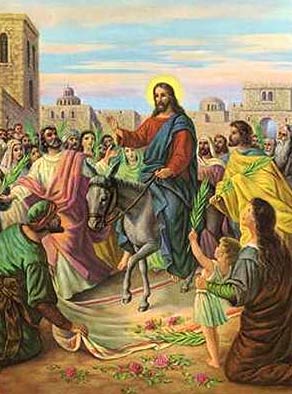
Palm Sunday imageWe’re going to go ahead with a couple of Easter bits, because next Monday will be too late. 

Easter gardenAbove: Easter garden. Look carefully, that’s a flower pot base.

Continue reading →

Real Victory

The next day the large crowd that had come to the feast heard that Jesus was coming to Jerusalem. So they took branches of palm trees and went out to meet him, crying out, “Hosanna! Blessed is he who comes in the name of the Lord, even the King of Israel!”
-John 12:12-13

On Palm Sunday we celebrate Jesus’ entry into Jerusalem for the last time. All four Gospels record what is known as the triumphal entry. By the end of the week the crowd had turned, and those shouting “Hosanna” would shout “crucify him.” The triumphal entry appeared to be Jesus’ finest hour and the crucifixion appeared to be his greatest defeat.  Things are not always as they appear. Christians recognize that Jesus’ most important work was done on the cross, as he humbly submitted to the will of the Father. Continue reading →

Palm Sunday: the Triumphal Entry

Reblogged from March 28, 2010

Several well known statements are found in Psalm 118:1-25: “His steadfast love endures forever,” “this is the day the LORD hath made,” “the stone the builders rejected has become the cornerstone,” and even others still.  Verse 25 reads “Save us, we pray, O LORD” in the ESV; “O LORD. we beseech thee, save us now!” in the King James.  The Hebrew word rendered in English as save now is hosanna. Continue reading →

Happy Monday

Happy Monday: Coffee Drinkers Edition 

There are people out there that don’t drink coffee, but they’re probably not even up yet. So whether you’re a Starbucks aficionado or a cup ‘o Joe kinda guy, here’s to you. Wake up and smell the coffee, and have a Happy Monday!

Don’t feel left out if you’re the non-caffeinated type; just consider the last 32 Mondays in a row that we didn’t feature coffee your special treat.

coffee w Batman

Continue reading →

The Bible, Part 3

Bible, on HistoryI’m still watching the Bible on History. My simple prayer before it began was that it not be stupid. It certainly isn’t stupid; the film is well made, filmed on location and for the most part tells the Bible story. I understand that some things must be left out and others abbreviated.  I understand dramatic license when adapting a story into a screenplay. And yet with each installment I find myself wondering why deviate from scripture when there is no need? Some details we might wish for are simply not found in the text, but why change those that are? For those of us that know the biblical account the film recreates, the differences are at times pretty bold. Continue reading →