
Enter his Gates with Thanksgiving

Christimas is the celebration of Jesus’s birth, but there is no biblical command to observe it.  There are however feasts, songs and prayers of thanksgiving are all over the Bible.  I’m not saying there is anything wrong with Christmas; during his lifetime Jesus was an observant Jew, and every indication is that he ovserved all the Jewish festivals, including the historical ones not just the religious festivals commanded in scripture.  The arrival of “God with us” is a major turning point in all of history.  But we are commanded to praise God and give thanks.  Moses sang songs of thanksgiving, David composed them.  James reminds us that “every good gift and perfect gift is from above.”  The United States was the first country to observe a national holiday for giving thanks.

Enter his gates with thanksgiving, and his courts with praise! Give thanks to him; bless his name! -Psalm 100:4

The word thanksgiving appears 9 times in the Psalms.  It appears a total of 42 times in the ESV Bible.  Click here to see them all.  If you look up variants, such as “give thanks,” you will find many more.  Whatever you read, however you celebrate, do not forget to thank God.  No matter what this year has been like, there is much to be thankful for.
ESV Online

I’ve been linking passages and references from my blog posts to ESV text as long as I’ve been blogging.  ESV.org used to be where all of those links were directed to.  For example, if you click this John 3:16 link that verse appears in a separate window.  Well, things have changed.  I’m usually hesitant to accept any type of change whatsoever, but the fact of the matter is sometimes we just have to deal.  The good people at Crossway are of course always looking to improve our experience with the ESV Bible, and here’s what that means to you.

ESV.org is now the place to learn about the ESV Bible.  You can read about it’s history and the people that endorse it, find out about the translation philosophy behind it, study it’s features and more.  This site answers every question imaginable about the ESV, but the text of the Bible itself is not there.  ESV Online is now the place to read the ESV text as well as access features and notes from the Study Bible.  When the ESV Study Bible first came out, you needed to purchase a copy in order to gain access to the online resources.  Purchasing the digital access only was also an option.  The Study Bible website is being phased out, and existing user profiles are being migrated to ESV Online.  Readers can now sign up for a free account.

The ESV Bible in the previous format (the one I linked at top) is still accessible for the time being.  I will continue linking scripture references from my blog posts as long as it is available; I particularly like the advanced search features.  At any rate, I’m updating the ESV page – note the tabs up top – and my links in the sidebar to reflect the changes.  When I first starting using the ESV, very few resources were available and I’m glad to be able to share them now.

Bible Survey: Jacob’s Ladder

I’ve just added a new post to Bible Survey, my 30 year plan for reading through scripture!  I exaggerate slightly.  At any rate, Jacob’s Ladder explores Genesis 28.  Describing Jacob’s dream is easy; interpreting what it means, that can be a different story.  Jewish and Christian traditions differ, but at the end of the day I think there’s only one place we can land: it’s about Jesus.

Read Genesis 28: Jacob’s Ladder at Bible Survey.

The Church Year

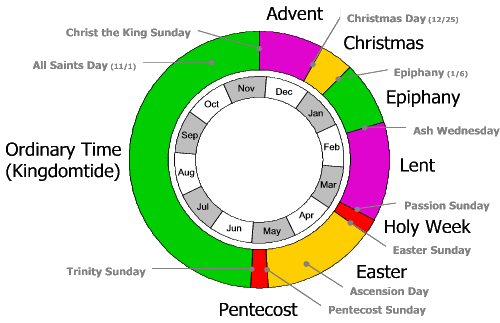
Chaplain Mike is doing a series on the liturgical church year at Internet Monk.  I’m not going to link each post, but this is the introduction.  The first follow-up has already been posted.  We are about to enter the season of Advent, and this would be a great time to start.  I grew up in the Baptist tradition which tends to do little with liturgy, but even the SBC churches I’ve been in light the candles of the Advent wreath each week.  If the concept of the Christian calendar is new to you, I highly recommend following Chaplain Mike’s series.

(No) Peace in the Middle East

This short film offers a simple answer to a complex question: Why has there not been/ will there not be peace in the Middle East?  Simple answers often require a lot of qualifiers, but this actually does a pretty good job.

…

We could of course turn this into a discussion of Bible prophecy.  There has never been peace in this region, and the Jews have been, are and will be despised by all nations.  When Pilate said he did not want this man’s blood (Jesus) on his hands, the Jewish mob cried out “Let his blood be on our hands, and on our children.”  It’s hard to not make the correlation between that event and the destruction of the Temple in A.D. 70.  The first century diaspora is why there were 10 million European Jews in 1936.  The Holocaust resulted in 100,000 Jews immigrating to the United States, and more importantly the creation of the Jewish state described in the video.  I find it hard to miss that hand of God in all this.

Many students of prophecy also believe there will be a miraculous peace brought to the Middle East by the Anti-Christ.  Now we are really stirring the pot.  Like I said, good video.

The Newest International Version

Print editions of the 2011 NIV will not be available until March of 2011, but you can find the text online now.  On November 1st, Bible Gateway (in my sidebar to the right) and the Biblica website (the new name for International Bible Society) switched to the new NIV 2011 text.  If NIV was your default version on Bible Gateway, it automatically updated your search results to return new NIV verses.  When released in print next spring, the name of the new version will simply be NIV, as opposed to NIV 2011 or some other indicative title.

According to the Biblica website, 95% of the biblical text remains identical to the 1984 version currently in use.  The 5% of verses that are rendered in a new way are not spread out equally, however.  Some Old Testament books are left virtually untouched, but Galatians is over 32% new and improved.  Well, perhaps “improved” is subject to interpretation.  You will have to read, compare, and draw your own conclusions.

The NIV is not my favorite translation, but you could certainly do worse.  I would rather a person read ANY Bible than not read the Bible at all.  I grew up reading KJV and have read the NRSV, which is very similar, in its entirety.  I had planned to make the NIV the next Bible I read through when I was introduced to the ESV.  My preference for the ESV should be clear.  My philosophy on Bible translations is to never rely solely on any one translation.  When I really want to understand a passage, I research the Greek (or Hebrew) words involved, read a few commentaries, and consider multiple translations.  I have studied enough history of the Bible, and am just bi-lingual enough, to know that translation is subject to interpretation.

If the NIV is your favorite, then you have probably known since late summer 2009 that a new one was coming.  Do some online browsing and see what you think.  For everyone else, the new NIV is what people are going to be talking about for the next few months, especially after March.  Before you talk about it, be sure to know something about what you’re talking about.

My Jesus is Bigger Than Your Jesus

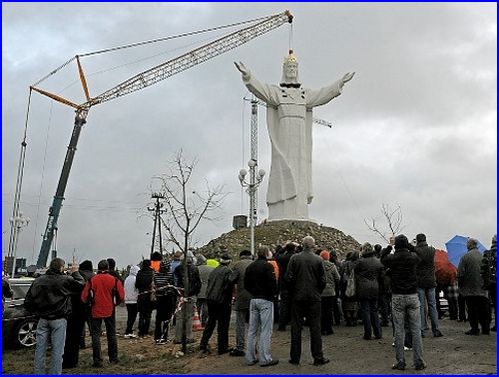
Swiebodzin, Poland is now home to the largest statue of Jesus in the world. At 167 feet, it is more than 40 feet taller than Christ the Redeemer in Rio de Janeiro.  Swiebedzin is a town of 22,000.  One hope of the community is that this will put them on the map and bring tourism – and tourist dollars.  Full story on Economic Stimulus Jesus here. Please share thoughts/ideas/opinions on what this means.

On a related note, remember what happened to the King of Kings?

New Features Available

I’m usually not among the first people to embrace a new trend.  My wife told me about Facebook two years before I signed up.  I wish I had bailed on MySpace sooner.  I also like for my blog to feel familiar; I’m annoyed when I visit a site of any kind regularly and it looks different every single time.  Find a theme/design that works for you and leave it alone.

That being said, I realize others embrace new trends and technologies more quickly than I do.  I added a Tweet feature a few weeks ago at the bottom of each blog post, and a few of my recent posts have been re-tweeted.  A few.  So, for the convience of my readers and fans (and to possibly attract new ones) several sharing features have been added.  At the bottom of each post, buttons appear for twitter and Facebook.  There are additional features under the “share” tab for e-mail, print, reddit, digg and StumbleUpon.  The number of mobile web devices and those socially networked is ever increasing.  The way to reach a mobile broadband world with the Gospel is to use the tools and media they are using.

The Grace to be Christ-Like

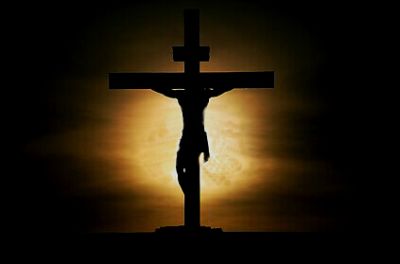
A couple of days ago I published The Challenge to be Christ-Like on the blog Life in Mordor.  It’s a group blog that I contribute to.  In Luke 23:34, while Jesus is hanging on the cross, he prays “Father forgive them, for they know not what they do.”  How can anyone be that Christ like?  Perhaps some have given sacrificially, prayed for our enemies, served on the mission field, maybe even given up their own life to save another.  Jesus prayed the prayer of intercession for the very people mocking him while they crucified him.  And we are commanded to have the same mind in us (Phil 2).

As I have continued to think about this challenge, I am reminded of a couple of things. One, we are never tempted beyond what we can bear.  God knows what we are made of, and he has searched and knows each heart.  As we learn from Job, the devil is on a leash.  Even when he’s the devil, he’s God’s devil.  Secondly, and more importantly, is the promise that God’s grace is sufficient to meet each need.  His grace provides our daily bread, as Jesus taught us to pray and history demonstrates in Exodus with the heavenly manna.  When Elijah asks the widow to feed him (1 Kings 17) she was just about to make one cake for herself, one for her son, and then they were both going to starve to death.  By God’s grace, she makes three cakes and they each have a small meal.  The next day, there was enough flour and oil for one more day; and the same the next day, and the next day, and the next day.  There was always just enough; the Bible never says one morning the bowl was full of flour, nor the bottle full of oil.  God’s grace was sufficient daily.

By the way, the original challenge was about being Christ-like to the extreme.  I asked who besides Jesus himself could do what he did on the cross.  Read Acts chapter 7.  As Stephen is being stoned to death, he prays in verse 60 “Do not hold this sin against them.”  It’s one of those “With God all things are possible” moments.  When the time comes, his grace is sufficient for whatever he has called us to.

I Preached on Baby Diapers

Father's Day, June 2010

I know what you’re thinking: the stress of working in full time ministry with a 14 month old at home has finally caused me to crack.  I reached a breaking point if my sermon is on changing diapers.  It’s not as bad as all that.  Let me explain.

Last week I preached this sermon on Galatians 4.  It’s about God adopting us into his family.  I had three well-defined points, as a good Baptist preacher should.  Today I preached that same sermon for our students in their Sunday a.m. chapel service.  I can’t take for granted that 6-12 graders know their Bible stories that way my church congregation does.  I cut some of the scripture citations and needed a more colorful analogy or two.  The first point in the sermon is that we are naturally the enemies of God.  He says “Do this” and instead we do that.  Adam and Eve are the first example, and not much has changed since.  I talked about how cute Johannah is; all our students know this to be true.  But when we’re changing a diaper, sometimes she quits being so cute.  If she sits up, rolls over, or otherwise tries to escape then everything takes longer.  We have to do things twice; or three times.  The students all smiled, nodded and laughed.  Then I pointed out that in my history class some of them are the same way.  I have to repeat myself and/or do things twice.  Sometimes three times.  That’s our nature.

It gets worse.  God sent his Son.  Like the father of the prodigal, God waits and watches down the road for us to come home.  The prodigal son (Luke 15) spent a fortune on good food, good wine and loose women.  Eventually he hit rock bottom, and desired the same slop that he fed pigs.  He had to learn that lesson the hard way.  You couldn’t have told him any different, and if the father had come looking for him any sooner, he would have ran as fast as he could in the other direction.  We were all wallowing (or are still wallowing) in our own filth.  We are slaves to sin, whatever sin you want to fill in the blank with.  If my daughter Johannah has filled her diaper, then she is basically sitting there in her own mess.  She stinks.  Yet when I reach for her she runs away.  She ducks and dodges.  Her natural impulse is to escape the diaper change.  Are we any different?  We wallow in our filthy sin, in our own mess, and push God away even as he wants to clean us.

God loved us when we were unlovable.  That’s the Gospel.  And if you have kids, had kids, or know parents with new kids, fell free to preach the Gospel according to dirty diapers.