 I can tell that Easter is near. Every year about this time, several television specials and news magazines focus on the fact that Christians still believe in Jesus even though they should not. In about a week, expect Time Magazine (or its equivalent) to run a cover story on how/why the resurrection could not have possibly taken place. Predictably, they will claim Jesus either 1) did not die 2) stayed dead, or 3) was never alive in the first place. Each year, several media outlets predict an end to Christian faith, despite the fact that each year there are still billions of Christians around the world. Continue reading
Tag Archives: Easter
Ash Wednesday
Today is Ash Wednesday. Easter will be in 46 days. I wrote a decent post last year (not my best ever) titled Ash Wednesday, Lent, and p.s. Mardi Gras. It’s sort of a Christian Calendar for Dummies. I’m satisfied to link that for now, and will have some new stuff up before Holy Week.
The Pagan Roots of Halloween; and Easter and Christmas
 Just like the Internet Monk rants here, I was raised in a fundamentalist Baptist home. We read the King James Bible, went to Sunday School, prayer meeting, revival, and every other time the church door was open. We didn’t wear shorts at my childhood home, nor go swimming in mixed company. My dad went to the public school and had me excused from the two weeks of swimming our P.E. class had in August. Dad was a street preacher, standing on the corner of a downtown city block shouting the Gospel at passing traffic. (He still does that once a week, but I no longer hand out tracts to pedestrian passersby.)
But you know what my parents did let us do? Go trick-or-treating. Continue reading
Final Thoughts on Holy Week
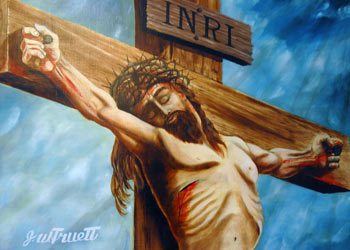 This year for Holy Week I pointed out that Jesus died. We all know that he was crucified, and was raised to life again, but the real miracle here is that God died.
We asked the question Jesus, sheep or shepherd? That post will be my sermon for Easter Sunday. I’m preaching twice in the morning.
Another thought was on Jesus’ prayer from the cross. He didn’t pray just for his followers or his family, but he prayed the prayer of intercession for the people who were crucifying him. “Father forgive them, for they know not what they do.” This is the Christ that we are supposed to be like.
There are some older posts I thought about re-posting, but instead I will just link them here. He Cannot Save Himself is a poem about the crucifixion. It is based on the sermon I preached for Easter last year. Feel free to copy and paste it, print it in your church bulletin, or read it outloud.
Other good topics for Holy Week are Jesus’ Examples: Washing Feet and Passover Becomes the Lord’s Supper.
Thoughts on Holy Week: Jesus Died
I know, perhaps you’re thinking “Well duh.” But give it just a little more thought than that. This is God’s only son we’re talking about here. As a matter of fact, Jesus is God.
On Easter we will celebrate the resurrection. Jesus wasn’t just resurrected, he IS the resurrection. So we’re not simply celebrating the fact that Jesus rose from the dead. He was not the first to rise again. That miracle had happened more than once already. But when Jesus hung on the cross, it was the first time that God had ever died. Two of the gospels recorded Jesus’ birth; all four record the crucifixion. In Matthew’s Gospel, he records the sky going dark until the 9th hour (3 p.m.). Only Matthew goes on to say that the veil was torn in the temple from top to bottom, and the graves of the saints opened up. The Old Testament saints went through the street of Jerusalem prophesying (Matt. 27:45, 51-53). The darkness, the earthquake, the veil, the saints, all highlight an extraordinary event taking place that day. I’m thinking of a few other scriptures beyond the gospels: Continue reading
Ash Wednesday, Lent, (and p.s. Mardi Gras)

Ash Wednesday
Ash Wednesday occurs 46 days before Easter, 40 days if you don’t count Sundays. This year it fell on February 25th. This marks the beginning of Lent, a time of preparation for Holy Week. At an Ash Wednesday service, part of the ceremony is placing ashes on the forehead as an outward symbol that you will be observing Lent. During the 40 day period something is given up, anything typically important to the individual, and more time spent in prayer, worship and meditation. Lent is about preparing ourselves spiritually to observe Holy Week, the days between Palm Sunday and Easter. Continue reading
Hindsight is 20/20
 Hindsight is 20/20 means that anything you look back on is easier to understand that it was at the time. We make decisions in the now, then sometimes realize later we acted too quickly, neglected certain facts, or else were simply uninformed. Hindsight being 20/20, we would have done things differently if we could just have seen the big picture. Continue reading
Holy Week
How many people will sit in churches on Easter Sunday and listen to a good sermon about the crucifixion of Jesus? Don’t get me wrong; if you’ve read my previous posts, it’s certainly a good thing to hear the crucifixion being preached in the pulpit of any church. Not every church in America has that anymore, Easter Sunday or otherwise. But most every Christian that celebrates Easter is also familar with Palm Sunday. Nearly as many know about Good Friday. This entire week between Palm Sunday and Easter is known in many traditions as Holy Week, but it is not celebrated by as many Christian worshipers as it once was.
Palm Sunday reenacts the triumpful entry, the day Jesus rode into Jeruselum to shouts of “Hosanna,” or in effect “Hallelujah!” Many were expecting him to proclaim himself Messiah, take the throne, and begin his reign as the king of the Jews. By the end of the week, many of those same Jews who cried Hosanna would cry out “Crucify him” before Pontius Pilate. On the Christian calendar, each day of this week has a title and special significance. It was during this week that Jesus shared what we now know as the last supper with his disciples. He took the Passover meal, the rememberance of how the sacrifice lamb saved the Hebrews while in Egypt from God’s judgement, and gave it new meaning. He told his followers to still break the bread and take the cup, but to do it in rememberance of him. This was the week that he washed the disciples feet as a lesson of humility and servanthood. And in the Garden of Geseminee he was betrayed by Judas Iscariot. He was tried falsely by Pilate, and crucified on what we know as Good Friday. All of these events before Easter Sunday, though leading up to that climax.
See, what I’m saying is that Easter isn’t about the crucifixion of Jesus. Easter celebrates the resurrection of Jesus from the dead. Holy Week is the time to remember his last supper, lessons in the vineyard, final words to his followers, and the events of his death and burial. Saturday is the time to be sad; it seems evil has triumphed, Death has been victorious, the disciples are scattered, and Mary is mourning the death of her son. On Sunday, it all changes. The captive of Death is set free, Jesus rises in newness of life, and hope is given that as Jesus is raised so shall those of us who die in Christ be raised. Easter celebrates the resurrecting power of God, who made all things in the universe which obey Him. Easter Sunday is about hope, life, redemption, reward, and in short all things being made new. Many others before and after Jesus claimed to be the Messiah, but he is the only one sitting at the right hand of God who ever lives to make intercession.
I know why it happens. Many marginal Christian believers will come to church that day who will not be back until either Christmas or perhaps next Easter. The pressure is on to get the Gospel out while the chance is there. But the rest of us need to remember that Easter is not about the end of life, but the beginning of resurrected life. It is the time to celebrate, and it’s why we meet on Sunday and not the Old Testament Sabbath. Be gloomy on Saturday, but don’t forget that joy comes in the morning. (And if you know about sunrise service, joy comes very early in the morning.)
 The Master's Table