Tag Archives: Jesus
Good Friday
I decided not to post it again this year, but here is a link to He Cannot Save Himself.

The Lord’s Prayers
Reblogged from April 1, 2012. Originally Holy Week: Three Prayers of Jesus
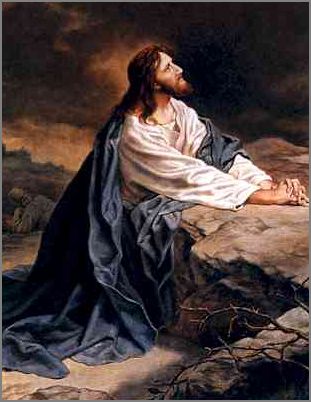 When Jesus taught his followers how to pray, he gave them a simple formula (such as in Matthew 6). We often called this the Lord’s Prayer, but Model Prayer or even Disciples’ Prayer would be more descriptive. Here are three prayers Jesus himself prayed during Holy Week.
The High Priestly Prayer (John 17) This entire chapter is a prayer spoken by Jesus that we call the High Priestly Prayer. The writer of Hebrews goes to great lengths to detail the ways Jesus acts as our high priest, continuously going into God’s presence and making intercession on our behalf. His prayer in John 17 casts Jesus in the role of High Priest, bridging the gap between man and God, between the unholy and Most Holy. Jesus has only a few days left on earth at this point in the story, and is about to take his place at God’s right hand. Jesus prayed for his followers of that day and all that would ever believe and follow in the future. Jesus literally prayed to God for us. Continue reading
Prophetic Words – Part 2
When they heard this, they were enraged and wanted to kill them. But a Pharisee in the council named Gamaliel, a teacher of the law held in honor by all the people, stood up and gave orders to put the men outside for a little while. And he said to them, “Men of Israel, take care what you are about to do with these men. For before these days Theudas rose up, claiming to be somebody, and a number of men, about four hundred, joined him. He was killed, and all who followed him were dispersed and came to nothing. After him Judas the Galilean rose up in the days of the census and drew away some of the people after him. He too perished, and all who followed him were scattered. So in the present case I tell you, keep away from these men and let them alone, for if this plan or this undertaking is of man, it will fail; but if it is of God, you will not be able to overthrow them. You might even be found opposing God!” So they took his advice. (Acts 5:33-39)

Prophetic Words – Part 1
 As Abraham was on his way to sacrifice Isaac, the boy made an observation: they had fire and wood, but no lamb to sacrifice. Abraham replied “God will provide himself a lamb.” That day he offered up a ram caught by his horns in a thicket, but we can see something of a prophesy in Abraham’s words: “God will provide himself with a lamb.” Abraham could not have been speaking, at least in his own wisdom, of the Lamb of God that takes away the sin of the world. But we get it. Now consider these words of Caiaphas: Continue reading
Two Tests of Faith
 And from there he arose and went away to the region of Tyre and Sidon. And he entered a house and did not want anyone to know, yet he could not be hidden. But immediately a woman whose little daughter had an unclean spirit heard of him and came and fell down at his feet. Now the woman was a Gentile, a Syrophoenician by birth. And she begged him to cast the demon out of her daughter. And he said to her, “Let the children be fed first, for it is not right to take the children’s bread and throw it to the dogs.” But she answered him, “Yes, Lord; yet even the dogs under the table eat the children’s crumbs.” And he said to her, “For this statement you may go your way; the demon has left your daughter.” And she went home and found the child lying in bed and the demon gone. (Mark 7:24-30 ESV)
Jesus’s response seems harsh. Is he calling this woman a dog? The short answer is yes. He was a Jewish messiah sent to the Jews, and she was of mixed Greek heritage and in short a Gentile. The Jews had two classifications of people, Jews and everyone else. But Jesus knew the thoughts and intents of her heart; her faith was in Jesus to heal her daughter. She was trusting him to do for her what no one else could. Jesus tested her in such a way as to make her faith public. Recall his words to the woman with the issue of blood: “Your faith has made you whole.” When put to the test, she passed with flying colors. Belief can be stated, faith must be demonstrated. Continue reading
The Fourth Man in the Fire
 In Daniel chapter 3, Shadrack, Meshach and Abednego were called to appear before King Nebuchadnezzar. They were charged with not worshiping the gods of Babylon nor bowing down the golden image of Nebuchadnezzar himself. He is willing to give them another chance, and if they will bow down then all will be well. But instead:
Shadrach, Meshach, and Abednego answered and said to the king, “O Nebuchadnezzar, we have no need to answer you in this matter. If this be so, our God whom we serve is able to deliver us from the burning fiery furnace, and he will deliver us out of your hand, O king. But if not, be it known to you, O king, that we will not serve your gods or worship the golden image that you have set up.” -Daniel 3:16-18 Continue reading
One Person’s Testimony
 We’ve all heard stories of a single vote that decided the fate of an election, or remember the lesson of the Knight Rider: One person can make a difference. But have you ever been alone in a crowd when it comes to Christian faith? Even if no one says anything negative, the temptation is to clam up about anything religious, to simply go with the flow. Can one believer really make a difference? Continue reading
Happy Monday

Child of Two Worlds
 Moses was born during the time the Hebrews were enslaved to Egypt, and male children were being thrown into the Nile. Because Pharaoh’s daughter had found Moses floating in a basket and raised him as her own, he grew up in the house of Pharaoh. Moses became the product of two cultures; his adoptive mother immediately identified him as Hebrew and found a Hebrew women to nurse him. (Which just happened to be, if you believe in that sort of thing, his real mother.) But he was raised as a prince of Egypt. He had a crisis of identity when he saw a Hebrew being beaten by an Egyptian, one of his own people (Ex 2:11) and he struck and killed the Egyptian. The very next day he tried to resolve a conflict between two Hebrews and was asked who appointed him as judge. “Do you mean to kill me as you killed the Egyptian?” The Hebrews rejected his leadership because they identified him as a member of Pharaoh’s house, and after learning of the Egyptian’s death at his hand Pharaoh sought to kill him. This is when he fled Egypt for Midian, where he laid low for the next 40 years. Continue reading
 The Master's Table
