 Genesis 22 tells the story of the sacrifice of Issac. Well, Isaac wasn’t really sacrificed but it was a close call. The point of the story is that Abraham was willing to sacrifice his son, thus passing his test of faith. As they were going up the mountain, Isaac notices they have wood and fire and actually asks his dad about not having a lamb. Abraham says “God will provide himself the lamb.” (Gen 22:8) After he was stopped – at the last possible moment – from sacrificing his son, he saw a ram caught by the horns in a thicket. That lamb was slain as an offering of thanksgiving. But did Abraham really know? He reasoned that Isaac’s birth had itself been a miracle, and if God chose he could restore Isaac to life. Now think about Jesus on the cross, the lamb of God that takes away the sin of the world. Recall Abraham’s words: God will provide himself the lamb. Truer words were never spoken. Continue reading
Tag Archives: Jesus
It’s Friday; Sunday’s Coming
Vocals by S.M. Lockridge, images from The Passion of the Christ
To see animation instead of the movie scenes, watch here.
He Cannot Save Himself; a poem for Good Friday
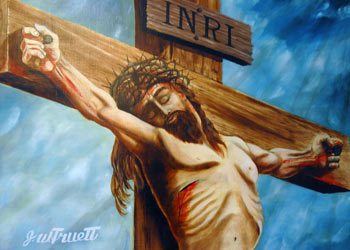
He Cannot Save Himself
Many questions were asked of him,
though no answer was heard.
Pilate pressed him to respond,
but Jesus spoke not a word.
As prophesied by Isaiah,
like a lamb he was silent.
Which angered the crowd even more,
and they began to riot.
Governor Pilate faced the Jews,
and in order to honor custom,
told them that at their choosing,
he would release one prisoner among them.
He knew that Jesus was delivered
out of envy, malice and vice.
But the crowd choose Barabbas,
shouting “Crucify Jesus Christ.”
Pilate washed his hands before them,
saying “I am innocent of this man’s blood.”
The crowd said “Let his blood be upon us,
and upon our sons.”
They stripped off his own garments,
placed on him a robe and crown.
And then pretended to worship,
before him kneeling down.
They placed on his head
a crown made of thorns.
Then they spat, hit and slapped him,
and mocked him to scorn.
They compelled the man Simon
to carry his cross.
And divided his garments,
by casting lots.
They made for him a sign,
placed over his head.
“This is Jesus, King of the
Jews” the words read.
Thieves were crucified with him,
on his left and his right.
One was loud and boastful,
the other more humble, contrite.
“We are guilty of our crimes,
and deserve to die this way.”
And when Jesus saw his faith,
promised paradise that day.
“He cannot save himself” they mocked,
as his blood fell to the ground.
But they were crucifying an innocent,
in whom no guilt was found.
This was God’s plan of salvation,
established before there was time.
Each event had been prophesied,
and now fell perfectly in line.
The trial, the false witness,
his hanging on a tree;
It was all prophesied clearly
in Isaiah fifty-three.
So the words of their mocking
are actually true, you see.
He could not save himself, for
on the cross… he saved me.
…
Clark J. Bunch
re-posted from 2/17/2009
Special Effects of Biblical Proportion
 We live about an hour away from a big church that puts on a very good passion play each year. We took a group of students to see it earlier this week. I have some experience with drama, mostly on the technical side (sound, lights, set construction). There are some special effects that work well even in amateur theater to help the audience suspend their disbelief. This particular passion play uses a silk screen and shadows to show Jesus being scourged; a little bit of technical effect combined with good acting really sell the scene.
Movies have a whole other dimension of effects available, and today it is hard to tell what is real and what isn’t. Watching a play or film during Holy Week adds to our understanding by providing visual stimulation. We can read the story, discuss it, and even share it with others, but seeing and hearing the dramatization can still add to our experience. There are times when the Bible itself seems to have a flair for the dramatic and God uses some special effects of his own to drive the point home. After displaying his power and wonders in Egypt, the Hebrews cross the Red Sea on dry land and see Pharaoh’s army crushed by the same water. Mount Sinai shook and smoldered when God descended onto it. No other biblical display was greater than on the day of Jesus’ crucifixion. Continue reading
Holy Week: Three Prayers of Jesus
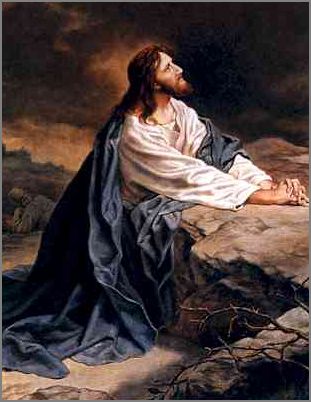 When Jesus taught his followers how to pray, he gave them a simple formula (such as in Matthew 6). We often called this the Lord’s Prayer, but Model Prayer or even Disciples’ Prayer would be more descriptive. Here are three prayers Jesus himself prayed during Holy Week.
The High Priestly Prayer (John 17) This entire chapter is a prayer spoken by Jesus that we call the High Priestly Prayer. The writer of Hebrews goes to great lengths to detail the ways Jesus acts as our high priest, continuously going into God’s presence and making intercession on our behalf. His prayer in John 17 casts Jesus in the role of High Priest, bridging the gap between man and God, between the unholy and Most Holy. Jesus has only a few days left on earth at this point in the story, and is about to take his place at God’s right hand. Jesus prayed for his followers of that day and all that would ever believe and follow in the future. Jesus literally prayed to God for us. Continue reading
The Appearance of Victory
 It looked like Jesus’ finest hour when he entered Jerusalem. Our Palm Sunday service, also called Passion Sunday by some, is a celebration of Jesus’ triumphal entry. The crowd shouted “Hosanna” and also “Blessed is he who comes in the name of the LORD.” Hosanna means either save us now or more simply save now. They waved palm branches, a symbol of victory, and spread coats on his path. Many expected Jesus to claim the throne, and some had even tried to take him by force and place him there. The Jewish leaders didn’t like it, but they feared the crowd more than God. Jesus certainly looked victorious on that day.
By the end of the week, the same crowd was shouting “Crucify him.” Followers of Jesus were hard to find by Friday afternoon. Good Friday seemed to be Jesus’ ultimate demise, the polar opposite of just a few days earlier. The chief priests and Pharisees must have thought the Jesus movement was over for sure as the few friends he had left put him in the tomb. Of course we know that Easter (Resurrection Sunday) and the day of Pentecost are coming soon, but Palm Sunday appears to be a great day of victory while the cross looks like defeat.
Try to keep these things in mind. The world often has their winning and losing backwards. When missionaries are persecuted, when pastors are arrested for reading the Bible in public places, when states approve gay marriage, or abortion rights are expanded: don’t be too quick to accept defeat. The same is true for events that we may perceive as victories. Political leaders and court systems of the modern world have no more real power than they did in the first century. The same Jesus that ascended in Acts 1 will return the same way. He will not be a helpless baby at his second coming. Despite appearances, the real victory was over death, hell and the grave.
“Sorrow may last for the night, but joy comes in the morning.” Psalm 30:5
Holy Week Review
 Palm Sunday is on April 1 this year, Easter will be April 8. That final week of Lent is referred to as Holy Week, and should be a special time in the lives of believers. Here are some Holy Week posts from years past; they may not be new, but are still good.
The “Triumphal” Entry is about Palm Sunday, the first day of Holy Week. The same Jews shouting Hosanna at the beginning of the week will be shouting Crucify him by the end of the week.
Who Framed Jesus? was a documentary shown by Discovery 2 years ago, but the same thing happens on t.v. and magazine covers every year. This post generated a frenzy of comments that are also a blast to read.
The Last Supper is about Jesus’ final Passover and the beginning of communion. And on the same night he washed the disciples’ feet.
Is Jesus the Sheep, or the Shepherd? This rather short post is one of the most read ever on The Master’s Table.
The Resurrection is the most celebrated event in Christianity, but here’s a thought: Jesus Died. Jesus is God; have you ever thought that all the way through?
He Cannot Save Himself, the original post and He Cannot Save Himself, a poem for Good Friday.
It’s Friday, Sunday’s Coming Sermon by S.M. Lockridge, with scenes from The Passion
And finally The Importance of the Resurrection.

About My Father’s Business
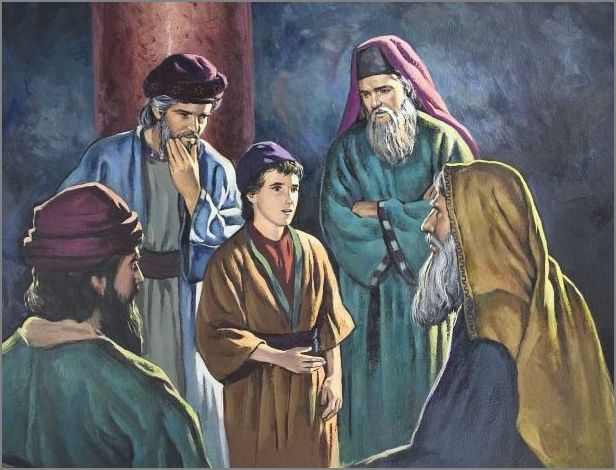 One year as the returned home from Passover, Mary and Joseph discovered that Jesus was not with their group. They searched among their relatives and acquantances, then went back to Jerusalem to look some more. They found the 12-year-old Jesus in the temple, asking questions and reasoning with the temple priests. “Why have you treated us this way?” Mary demanded. She expressed her concern and distress as they didn’t know where he was these past two days. “Did you not realize that I must be about my father’s business?” Jesus replied. (The ESV says in my father’s house.) Of course his parents could not understand what he was talking about. Luke 2:41-52
Jesus thought it was obvious. Why were they looking for him? He must be about his father’s business.
If you came up missing, where would people look for you? Should we go straight to God’s house, or perhaps the office? Or the golf course? Or the bar? Would we be found visiting the sick and afflicted, giving a cup of water to the least of his children? Or would we be somewhere else?
Look at Christ and consider the example. We must be about our father’s business.
There’s More Than One Way to Not Share the Gospel
What do Fred Phelps and Joel Osteen have in common? There’s no punchline, I really am going somewhere with this.

Fred Phelps is the pastor of the infamous Westboro Baptist Church. You’ve seen them in the news or online protesting military funerals and more recently posting statements of judgment on Twitter. I’ve never heard him say “Hell is hot and sin ain’t right” but I imagine he would agree with that statement. Phelps is completely occupied with God’s judgement. God does hate sin, and the wages of sin is death. That seems to be just about the only weapon in the Westboro arsenal. The message is a call to repent.
At the polar opposite end of the spectrum is Joel Osteen. He has never used the words wrath and God in the same sentence. Sin, the cross, the blood of Jesus, he quit preaching on those things years ago. He actually said in an interview that everybody has already heard those things. Osteen has his, um, church members hold up their Bibles each week, repeat some little mantra, then put them back down while he tells funny stories for another half hour. He is an excellent speaker – funny, polished, very encouraging – I just wouldn’t call him a preacher. His message is to think positive thoughts, believe that God wants to bless you, will bless you, and that nothing would please God more than to bless you. He has a million dollar smile, gorgeous wife, two books on the New York Times Bestseller List, and 50,000+ attendees every week at Lakewood “Church.” He’s doing much better in that department than Phelps, whose congregation consists mainly of his own family members. Continue reading
Tests of Faith
 It is an easy thing to say we have faith. Some may believe they have faith, until a trial actually arises and that faith is put to the test. Jesus, quoting Isiah, said that many people loved him with their lips but their hears were far from him. Some of the things Jesus said or did was because he sees through our speech and knows the heart. Consider these two examples:
When the Syrophenician woman came to Jesus his response seems pretty calloused. Her daughter was possessed by a demon, and she was asking Jesus to cast it out. His response is that it would not be right to cast the children’s bread to the dogs. He was a Jewish teacher, she was basically Greek. He literally and figuratively called her a dog. This was a test of her faith, and she responded wisely. “Yes Lord, but even the dogs under the table eat the children’s crumbs.” Jesus tells her to go her way, that her daughter has been healed.
Just a few chapters later is the story of the rich young man. He is either lying to Jesus, or more likely has deceived himself, when he proclaims he has kept all the commandments since his youth. Jesus tells him he lacks one thing: “Go, sell all that you have and give it to the poor, and you will have treasure in heaven; and come, follow me.” The man left very sad for he had great possessions. Regardless of what he said, his actions spoke louder than words. His faith was not in Jesus but in all that he had. He was depending on his wealth to see him through life, he could not let go and let God. By the way, don’t miss the part were Jesus looked at him, loved him, and then told him he lacked one thing. The testing of his faith forced him to be honest with himself and others about where his faith really was.
 The Master's Table