The Bible is About Jesus

The Bible is about Jesus.  I’m certain I have said this before, but after looking high and low for a post with that title I cannot find one.  So let me go on record making this statement: the Bible is about Jesus.

I did find a post titled Old Testament God is the God of the New Testament.  To some, there is almost two different Gods in the Bible.  In the Old Testament, God is angry, vengeful and scary.  He is more like Zeus or Thor than the mild-mannered, pacifist Jesus found in the New Testament.  Let me suggest that 1) like the Pharisees, you are not reading the Old Testament correctly.  While he is a God of judgement in the Old Testament, he is also patient and longsuffering toward the nation of Israel.  2) Jesus is not just presented in the Gospels as patient, kind and loving towards all.  He also raises his voice and drives the money changes out of the temple – with a whip in John’s Gospel!  Jesus is present as judge at the end of Revelation.  There is one God.  Perhaps a re-read of the text is necessary. Continue reading

Instead of a Mother’s Day Sermon…

Last year I read a rant from a woman that refused to listen to one more preacher read Proverbs 31 and tell her how to be a godly woman.  Right or wrong, she made a couple of good points.  1) She has a good teaching pastor that opened the Bible each week, delivered a solid scripture-based sermon and shared the Gospel.  Mother’s Day each year turns into a one hour Hallmark card.  2) There are those in the church who may have lost a parent, or a child, or perhaps are disappointed they cannot become parents.  Honoring mothers can be especially painful for those that have tried and failed.  And we personally know what that’s like. So, here is the sermon I preached on Mother’s Day, May 9, 2010.

God is relational.  He seeks a relationship with his people, who in a general sense are all his children.  Let’s begin with the relationship of marriage. Continue reading

To Ourselves and our Posterity

I’m going out on a limb here.  Maybe it’s getting late and this will just be the Diet Pepsi talking, but I would like to share a thought.

I recently met a blogger named Joe Derbes, author of Everyone’s Entitled to Joe’s Opinion.  I don’t know how much of an influence Michael Spencer was to him, but his blogroll credits Michael with being his new favorite Christian author.  I have certainly said before that I blog because of Michael Spencer.  I know that one student of Mr. Spencer says the same thing.  How many others are there?  The Internet was teeming with tributes to Michael in the days following his passing.  How many people out there blog, or perhaps blog with a different message or purpose, as a direct result of the original Internet Monk?

I can’t write a new post without considering how Michael would evaluate that installment.  I miss the constructive criticism; he made me a better writer.  He helped shaped my current view of systematic theology.  And tonight I can’t help but think of this: that’s kind of like Jesus.  Jesus taught multitudes of people, and 12 in particular were privy to special teachings, prayers and examples.  Jesus taught them, told them to follow in his footsteps, and then left them.  Two of the disciples wrote Gospels (and perhaps Mark was dictated by Peter).  Peter lead the others in starting the Christian church at Jerusalem.  Paul did just about the same thing.  He planted churches across Asia minor and southern Europe, training leaders and then moving on.  His letters to Timothy still guide church leaders today.

That’s the Christian model.  A teacher, a pastor, a blogger – in this case – not only does his job but teaches others to do the job as well.  Even as Paul was ministering he was training others to be ministers.  Even during his earthly ministry Jesus sent the Apostles out to preach and work miracles.  When the human life is spent the work continues.  The church grows.  The gospel goes forth.  We need to think now about the future generation of leaders that will be following our lead.  Heaven and earth will pass away but the Word of the Lord endures forever.

The Law of Love

Paul has a lot to say in his letters about the Law. Throughout the Book of Romans, the paragraphs have subject headers like “Judgement and the Law,” “Released from the Law,” “Sin and Law” and so on.  As a Pharisee, Paul had studied the Law well and enforced it.  As a Christian sharing the Gospel, he realized that the Law and the Prophets had been fulfilled in Jesus Christ.  His opinion of the Law remained very high.  Paul says the Law is like a tutor, or school master.  It teaches us about the attributes of God.  Living under the Law though would mean we are still subject to God’s judgement.  Living under grace is far superior to meeting the requirements of the Law.  Keeping the Law is a burden we cannot bear.

Paul also has a thing or two to say about love.  I was struck during my last read of Romans at how Paul relates love and the Law together.  Note this passage from Romans 13:

Owe no one anything, except to love each other, for the one who loves another has fulfilled the law.  For the commandments, “You shall not commit adultery, You shall not murder, You shall not steal, You shall not covet,” and any other commandment, are summed up in this word: “You shall love your neighbor as yourself.”  Love does no wrong to a neighbor; therefore love is the fulfilling of the law.  -Rom 13:8-10

Wow.  Love is the fulfilling of the Law; very similar to Jesus’s answer about the greatest commandment in Mark 12.  In that case, Jesus says the greatest commandment is to love God with all your heart, mind and strength and the second is like it, to love your neighbor as yourself.  There is no way to violate any one of the 10 commandments if this love is our guiding principle.  Which is exactly what Paul explains here.  In John 15, Jesus said things like “If you keep my commandments, you will abide in my love,” and even “I give you this commandment, that you love one another as I have loved you.”  I’m still amazed at the way Paul expresses love as the fulfillment of the Law.

Can You Really _______ for Jesus?

This is a promotional video for the Light of the World Ballet Company.  I’ve watched two performances today, and didn’t take a single picture or video.

These are professional performers who tour the world, entering places like India and China that perhaps wouldn’t be open to missionaries (preachers) and share the Gospel while they are there.  Perhaps only Baptists would even second guess ballet as ministry.  Are other denominations as critical of dancing?  “A praying knee and a dancing foot don’t grow on the same leg,” I was told by one preacher’s wife.  Very Baptist.

I told our students (private Christian school) that whatever God has gifted them to do, do that for the glory and honor of God.  How many country music singers learned to sing in church, or got their start in the church choir?  But let me open this box: Can you really do anything for the glory and honor of God? David danced before the Lord; Psalm 150 mentions dancing, blowing horns and crashing symbols.  But where is the line?  Can you skateboard for Jesus?  Bowl for Jesus?  Play in a Christian rock band?  Are there things “done for Jesus” that are really just whatever we wanted to do in the first place?  Can you really (fill in the blank) for Jesus?  Or maybe answer this question: What’s the strangest thing you’ve ever witnessed supposedly done for the glory of God?  I could easily link “preaching baby” again.

The New Thing in Sermons

In the Old Testament, the prophet was a person who did the speaking for God.  Not necessarily predicting future events, the prophet acted as the spoken voice of God on earth.  During Jesus’s earthly ministry, he was found daily in the temple or synagogue reading and teaching.  While his sermon on the mount may have turned the Pharisees’ world upside down, he was regarded as a rabbi in most Jewish circles.  In Acts chapter 2, on the Day of Pentecost, Peter preaches something entirely new. Continue reading

Memorial Service for Michael Spencer

UPDATE:  Check out internetmonk.com for transcript/ audio of the memorial service.

Services were held this afternoon for the Internet Monk Michael Spencer.  The Internet has abounded this week with articles of tribute and expressions of sympathy for the family.  David Head and Bill Haynes both did excellent jobs.  David has a remarkable understanding of how Spencer’s ministry reaches a worldwide audience through his blog, and Bill did exactly what Michael asked him to; he preached the Gospel. Continue reading

The “Triumphal” Entry

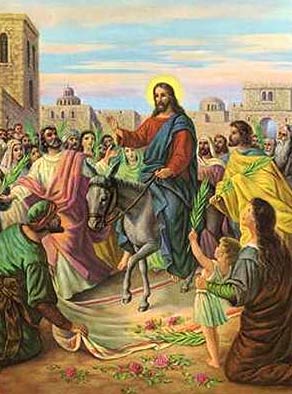
Several well known statements are found in Psalm 118:1-25: “His steadfast love endures forever,” “this is the day the LORD hath made,” “the stone the builders rejected has become the cornerstone,” and even others still.  Verse 25 reads “Save us, we pray, O LORD” in the ESV; “O LORD. we beseech thee, save us now!” in the King James.  The Hebrew word rendered in English as save now is hosanna.

All four Gospels tell the story of Jesus’s triumphal entry.  Palm Sunday is our celebration of Jesus entering Jerusalem for the last time to observe Passover with his disciples. Continue reading

Who Framed Jesus?

I can tell that Easter is near.  Every year about this time, several television specials and news magazines focus on the fact that Christians still believe in Jesus even though they should not.  In about a week, expect Time Magazine (or its equivalent) to run a cover story on how/why the resurrection could not have possibly taken place.  Predictably, they will claim Jesus either 1) did not die  2) stayed dead, or 3) was never alive in the first place.  Each year, several media outlets predict an end to Christian faith, despite the fact that each year there are still billions of Christians around the world. Continue reading

Jesus Greater Than Moses: Heb 3

Hebrews is easy to preach because its form is much more like a sermon than an epistle (letter).  At the heart of its message is an impassioned plea not to leave the Christian faith for another, and so in order to be convincing the author of Hebrews makes many comparisons between Christ and all the things of the Old Testament he is superior to.  We have already seen that Christ is superior to the angels, and that through suffering he becomes the perfect founder of our faith.  Chapter 3 begins this way:

Therefore, holy brothers, you who share in a heavenly calling, consider Jesus, the apostle and high priest of our confession,  who was faithful to him who appointed him, just as Moses also was faithful in all God’s house. For Jesus has been counted worthy of more glory than Moses—as much more glory as the builder of a house has more honor than the house itself.  (For every house is built by someone, but the builder of all things is God.)  Now Moses was faithful in all God’s house as a servant, to testify to the things that were to be spoken later,  but Christ is faithful over God’s house as a son. And we are his house if indeed we hold fast our confidence and our boasting in our hope.  Hebrews 3:1-6

Continue reading