The Fourth Man in the Fire

Screenshot 2013-03-10 at 2.19.14 PMIn Daniel chapter 3, Shadrack, Meshach and Abednego were called to appear before King Nebuchadnezzar. They were charged with not worshiping the gods of Babylon nor bowing down the golden image of Nebuchadnezzar himself. He is willing to give them another chance, and if they will bow down then all will be well. But instead:

Shadrach, Meshach, and Abednego answered and said to the king, “O Nebuchadnezzar, we have no need to answer you in this matter. If this be so, our God whom we serve is able to deliver us from the burning fiery furnace, and he will deliver us out of your hand, O king. But if not, be it known to you, O king, that we will not serve your gods or worship the golden image that you have set up.”  -Daniel 3:16-18 Continue reading

The Bible on History

Bible, on HistoryI said the same prayer for the History Channel’s presentation of the Bible that I did for GSN’s Great American Bible Challenge last summer: please Lord, don’t let it be stupid. For the sake of Christian’s everywhere, I hoped it would not be something I had to apologize for to non-Christians/ unbelievers.

The Bible premiered tonight on History. For the most part, I would have to say that I liked it. Getting the story of all scripture into ten hours is an ambitious undertaking. Some things must be left out, and other parts of the story condensed. But if that’s the case, then why add anything that is not included in scripture? For all the drama the Bible contains, why add anything for dramatic effect? The producers must have known that some of us would be watching that know the Bible well. For our sake, why not remain as true to the original as possible? Continue reading

One Person’s Testimony

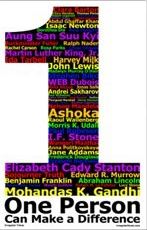
oneWe’ve all heard stories of a single vote that decided the fate of an election, or remember the lesson of the Knight Rider: One person can make a difference.  But have you ever been alone in a crowd when it comes to Christian faith?  Even if no one says anything negative, the temptation is to clam up about anything religious, to simply go with the flow.  Can one believer really make a difference? Continue reading

A Short Lesson About Reading the Bible

bibleThere’s an old saying about a little knowledge being a dangerous thing.  The key to understanding scripture is context.  If you quote half a verse to support any argument, the first thing I’m going to do is go find the whole verse, then read the whole paragraph.  We need to know who is writing, to whom, and under what circumstances before applying any particular verse to our situation.

There are always critics of religion in general and of Christianity in particular that insist religion was invented or the Bible was written to control people.  Roman emperors used religion to build an empire, Medieval kings used it to build wealth and add territory, and Christians today use scripture to justify everything from suppressing women to persecuting homosexuals.  Sadly, to some extent, each of those arguments have some merit.  Emperor Constantine made the switch from persecuting Christians to embracing Christianity in order to defeat the enemies of the Roman Empire.  I think we should blame Rome for that, not Christ.  The problem with the Middle Ages is that the vast majority of Europeans were illiterate.  If the kings and knights of Medieval Europe could have read the Bible for themselves, they would not have been so easily manipulated.  Thank God for Gutenberg,  am I right?  Which brings us to today. Continue reading

Things the Bible Doesn’t Say

bibleI started listing well known sayings that people tend to think are in the Bible but actually aren’t.  As the list got longer I began to realize they could all basically be grouped in three categories.  This also helps to understand some of the confusion.

Misquotes – In this case the often quoted statement is similar to actual Bible verses, perhaps abbreviated.

The best example is “Money is the root of all evil.”  What 1 Timothy 6:10 actually says is “The love (or lust) of money is a root of all kinds of evil.”  While the wording is similar, the meaning is quite different.  Money is neutral and the evil comes from our attitudes concerning it. Continue reading

Child of Two Worlds

Moses before PharaohMoses was born during the time the Hebrews were enslaved to Egypt, and male children were being thrown into the Nile.  Because Pharaoh’s daughter had found Moses floating in a basket and raised him as her own, he grew up in the house of Pharaoh.  Moses became the product of two cultures; his adoptive mother immediately identified him as Hebrew and found a Hebrew women to nurse him.  (Which just happened to be, if you believe in that sort of thing, his real mother.)  But he was raised as a prince of Egypt.  He had a crisis of identity when he saw a Hebrew being beaten by an Egyptian, one of his own people (Ex 2:11) and he struck and killed the Egyptian.  The very next day he tried to resolve a conflict between two Hebrews and was asked who appointed him as judge.  “Do you mean to kill me as you killed the Egyptian?”  The Hebrews rejected his leadership because they identified him as a member of Pharaoh’s house, and after learning of the Egyptian’s death at his hand Pharaoh sought to kill him.  This is when he fled Egypt for Midian, where he laid low for the next 40 years. Continue reading

A Seed Must Fall

wheatTruly, truly, I say to you, unless a grain of wheat falls into the earth and dies, it remains alone; but if it dies, it bears much fruit. (John 12:24 ESV)  I’ve heard that verse a couple of times this weekend, so it was fresh in mind when I started reading the Exodus this morning.  Let’s first put it in its proper context.

Nearly half of John’s Gospel deals with the events of the Passion week.  The Triumphal Entry into Jerusalem is recorded at the beginning of chapter 12, and this verse is spoken by Jesus in reference to his hour having come.  A seed must fall into the ground and die just as Jesus must go down into the earth by being placed in the grave.  John 12:24 is an illustration of how Jesus must die and be buried in order to rise again with new life.  By being obedient to the Father’s will, Jesus will produce much fruit for the Kingdom.  God speaks aloud in verse 27 and says that he has gloried Jesus’ name and will glorify it again. Continue reading

Blessings and Curses

The LORD bless you and keep you;
the LORD make his face to shine upon you and be gracious to you;
the LORD lift up his countenance upon you and give you peace.
(Numbers 6:24-26 ESV)

That is the blessing which God commanded Moses to give Aaron and his sons.  Aaron was the first high priest of Israel, and his sons were anointed to serve under him as priests.  This was the blessing they spoke over the people of Israel, so that God’s name went before them and he would bless them.  I like to place my hands on any man being ordained as a deacon or into the ministry and say these words.  It is a fitting and appropriate way to ask God’s blessing on others.

There is another phrase often borrowed from scripture Continue reading

The Bible on History

Bible, on HistoryMy degree is in history and political science.  I taught history for eight years, and if I’ve learned anything it’s this: take what you see on the History Channel with a grain of salt.

UPDATE: Read my review of episode 1 here.

I enjoyed America: the Story of Us so much that I bought the DVD set.  I watch Pawn Stars and American Pickers which are entertaining and quasi-historical.  But History is also the cable network home of reality series such Ax Men and Ice Road Truckers; and then there’s Ancient Aliens.  Everything on History (owned by A&E Networks) is not of equal historical value.  Let’s leave it at that.

Which brings me to The Bible.   Continue reading

God Loves You. God Hates Sin.

jesus-in-the-manger

If you want to know how much God loves you, look in the manger.

jesus_cross

If you want to know how much God hates sin, look at the cross. Continue reading