Our Mission is Not Their Mission

The Bible tells one story; the Old Testament and the New are both part of that story.  The message of scripture from beginning to end is how a holy God, perfect in righteousness, deals with humanity, which is fallen, broken and unrighteous.  At the center of that story is Jesus.

There is a definite relationship between the old covenant and the new.  I often describe Judaism as a analogy for Christianity.  The Hebrews in the Old Testament are analogous in many ways to Christians of the New Testament.  There are many similarities but we must be clear: the two are not the same.  The Hebrews came out of Egypt on a mission; as Christians we should be on mission.  But our mission is very different from their mission. Continue reading

Prophetic Words: An Easter Sermon

Genesis 22 tells the story of the sacrifice of Issac.  Well, Isaac wasn’t really sacrificed but it was a close call.  The point of the story is that Abraham was willing to sacrifice his son, thus passing his test of faith.  As they were going up the mountain, Isaac notices they have wood and fire and actually asks his dad about not having a lamb.  Abraham says “God will provide himself the lamb.”  (Gen 22:8)  After he was stopped – at the last possible moment – from sacrificing his son, he saw a ram caught by the horns in a thicket.  That lamb was slain as an offering of thanksgiving.  But did Abraham really know?  He reasoned that Isaac’s birth had itself been a miracle, and if God chose he could restore Isaac to life.  Now think about Jesus on the cross, the lamb of God that takes away the sin of the world.  Recall Abraham’s words: God will provide himself the lamb.  Truer words were never spoken. Continue reading

Special Effects of Biblical Proportion

We live about an hour away from a big church that puts on a very good passion play each year.  We took a group of students to see it earlier this week.  I have some experience with drama, mostly on the technical side (sound, lights, set construction).  There are some special effects that work well even in amateur theater  to help the audience suspend their disbelief.  This particular passion play uses a silk screen and shadows to show Jesus being scourged; a little bit of technical effect combined with good acting really sell the scene.

Movies have a whole other dimension of effects available, and today it is hard to tell what is real and what isn’t.  Watching a play or film during Holy Week adds to our understanding by providing visual stimulation.  We can read the story, discuss it, and even share it with others, but seeing and hearing the dramatization can still add to our experience.  There are times when the Bible itself seems to have a flair for the dramatic and God uses some special effects of his own to drive the point home.  After displaying his power and wonders in Egypt, the Hebrews cross the Red Sea on dry land and see Pharaoh’s army crushed by the same water.  Mount Sinai shook and smoldered when God descended onto it.  No other biblical display was greater than on the day of Jesus’ crucifixion.  Continue reading

Is Baptism Required for Salvation?

Ron Boatwright wrote this webpage, arguing that without baptism one is not saved, and then sent me an e-mail asking me to read it and tell him what I thought.

From the website:  Jesus says in Mark 16:16, “He who believes and is baptized shall be saved; but he who does not believe will be condemned“.  But just as 1+1=2, Jesus says belief + baptism = saved.  One needs help to misunderstand Jesus.  How much clearer could Jesus have said it?  Jesus placed both belief and baptism prior to being saved.

What Jesus said and what Boatwright claims he said are not the same.  Jesus lumps believing and baptism together as almost one single activity – he who believes and is baptized.  What Jesus says next is “He who does not believe will be condemned.”  Not believing equates with condemnation (hell).  In Mark 16:15 Jesus had told the disciples to preach the gospel to every living creature.  Those who believe that message, and are consequently baptized, will be saved.  Rejecting the gospel is what sends non-believers to hell, not refusing baptism.  If this were the case Jesus might have also said “He who believes but is not baptized will be condemned.”  He didn’t say that.  Jesus does not equate belief and baptism as being essential to salvation, but he is assuming belief and baptism are a package deal. Continue reading

About My Father’s Business

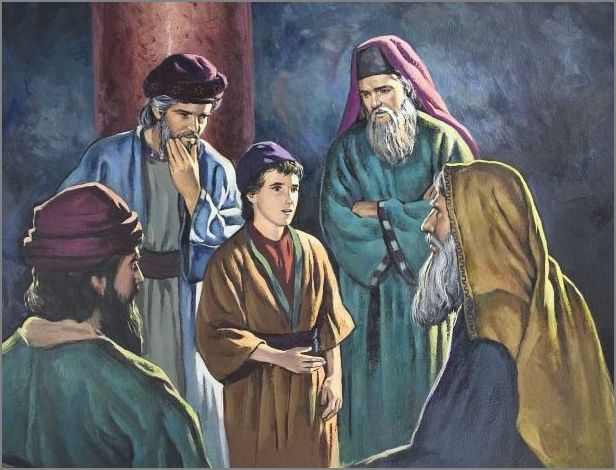
One year as the returned home from Passover, Mary and Joseph discovered that Jesus was not with their group.  They searched among their relatives and acquantances, then went back to Jerusalem to look some more.  They found the 12-year-old Jesus in the temple, asking questions and reasoning with the temple priests.  “Why have you treated us this way?” Mary demanded.  She expressed her concern and distress as they didn’t know where he was these past two days.  “Did you not realize that I must be about my father’s business?” Jesus replied.  (The ESV says in my father’s house.)  Of course his parents could not understand what he was talking about.  Luke 2:41-52

Jesus thought it was obvious.  Why were they looking for him?  He must be about his father’s business.

If you came up missing, where would people look for you?  Should we go straight to God’s house, or perhaps the office?  Or the golf course?  Or the bar?  Would we be found visiting the sick and afflicted, giving a cup of water to the least of his children? Or would we be somewhere else?

Look at Christ and consider the example.  We must be about our father’s business.

You Have to Be a Friend

There’s an old saying that goes “To have a friend, you have to be a friend.” The implication is that if you are friendly others will be friendly toward you. There is no guarantee that if you put yourself out there others will reciprocate. Even if you don’t have a friend, the Christ-like thing to do is be a friend anyway.

Greater love has no one than this, that someone lay down his life for his friends. (John 15:13, ESV) Jesus had 12 chosen apostles and a multitude of followers, but during his trial and crucifixion nearly every single one of them ran away. Jesus was a friend of sinners, healed legions of the sick and afflicted, feed thousands, but when the time came… he was left alone. His mother was there, and perhaps one disciple. Peter denied Jesus three times, and even invoked a curse on himself. After Jesus’ arrest in the Garden of Gethsemane, the rest had fled in fear.

Yet on the cross, Jesus extended mercy even toward the people that were nailing him to the tree. “Father forgive them, for they know not what they do.” We are told to give without expecting repayment, to walk the extra mile (literally) and  to turn the other cheek. Jesus’ final command was to love. We are to have the same mind is us that Christ had. Regardless of what anyone else does or doesn’t do…

You have to be a friend.

Surprised by Jesus

In the first chapter of Mark’s Gospel, Jesus begins his public ministry and gets right to it, so to speak.  By the end of Mark 1 Jesus has been baptized by John, tempted by Satan, called the first 4 apostles, cast out a demon and healed many people, including Simon Peter’s mother-in-law.

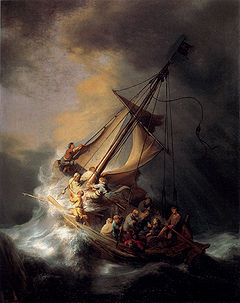
Jesus’ apostles know that he can heal the sick and cast out demons.  They were given power and authority to do those same things.  But at the end of Mark 4 they are filled when fear when Jesus calms a storm.  “Who then is this, that event the wind and sea obey him?”  They were surprised by Jesus, their own leader and teacher.  They had been given power to heal the sick, but seeing Jesus command the raging storm to be peaceful was more than they expected.  It appears they woke him up to help bail water.  He criticized their lack of faith, and it appears that even they don’t get.

I set out to write a sermon titled “Don’t be surprised by Jesus.”  He was, after all, the Son of God.  After everything else they have already witnessed and been a part of, how could they still not understand?  Along the way I realized that it is unreasonable to not be surprised by Jesus.  He is surprising, his grace is amazing, and his love and mercy surpass our understanding.  Throughout his ministry he is talking to women, eating with tax collectors, and touching lepers.  As he is nailed to the cross to die, he prays for the people crucifying him.  “Father forgive them, they know not what they do.”  If you’re not surprised yet, read further into the New Testament where we are commanding to think that way.  (Try Philippians 2)

We must not become so comfortable that we are not surprised by Jesus.  We can be lulled into such a sense of complacency that we miss the spiritual warfare going on around us.  There’s a line in The Lion the Witch and the Wardrobe that says of Aslan “He’s not a tame lion.”  Jesus is incarnate deity, maker of heaven and earth, who will one day judge the nations.  It’s a shame that after a time we get used to it.  Just don’t be surprised when you get surprised.
Can I Interest You in Hebrews?

Long ago, at many times and in many ways, God spoke to our fathers by the prophets, but in these last days he has spoken to us by his Son, whom he appointed the heir of all things, through whom also he created the world. He is the radiance of the glory of God and the exact imprint of his nature, and he upholds the universe by the word of his power. After making purification for sins, he sat down at the right hand of the Majesty on high, having become as much superior to angels as the name he has inherited is more excellent than theirs.  (Hebrews 1:1-4 ESV)

Jesus alluded to this truth in the parable of the tenants.  Colossians 1 describes the preeminence of Christ in all things, calling him the images of the invisible God.  Galatians 4 describes how God sent his son “when the fullness of time had come.”  Ephesians 2 elaborates on Christ making peace by the blood of his cross.  But this passage in Hebrews has a poetic quality to it.  This one paragraph encompasses all of these other references in one beautiful synopsis.  It’s about Old Testament prophecy and New Testament fulfillment.  It tells the reader who Jesus is and what he has done.  It describes the incarnation, ministry of Jesus and his current office as high priest.

I find this short passage simple, beautiful and powerful.  This is just the opening statement; have you read the rest of Hebrews lately?

There is Much to be Thankful For

A psalm for giving thanks.

Make a joyful noise to the LORD, all the earth!
Serve the LORD with gladness!
Come into his presence with singing!
Know that the LORD, he is God!
It is he who made us, and we are his;
we are his people, and the sheep of his pasture.
Enter his gates with thanksgiving,
and his courts with praise!
Give thanks to him; bless his name!
For the LORD is good;
his steadfast love endures forever,
and his faithfulness to all generations.
-David, Psalm 100

Easter and Christmas are the most prolific Christian holidays celebrated in the United States, but in the strictest sense those are not commanded in scripture.  As far as we know, the followers of Jesus never did anything special for his birthday.  Recognizing that the Son of God came into the world as incarnate deity is paramount to the Christian faith, but what I’m saying is that no verse in scripture instructs us to celebrate Christmas.  Further, Christians worship on Sunday rather than the Sabbath, or seventh day, because the resurrection was on the first day of the week.  In a sense, every Sunday is Easter Sunday.

We are instructed to give thanks. Continue reading

The Rich Young Man; Look Again

He came to Jesus professing he had kept all the commandments from his youth.  After Jesus told him to sell all he had and give to the poor, the man left very sad for he had great possessions.  We all know this story, there’s nothing else to learn from it right?  (It’s a trick question, don’t answer.)

The story of the Rich Young Man (or Ruler, historically) is accounted in Mark 10:17-22.  He asks Jesus what he must do in order to have eternal life.  Perhaps you’ve heard religion is what we do, the gospel is what Jesus does for us.  But Jesus tells him to keep the commandments.  The man replies he has kept all of the from his youth.  Now we know that he is either lying or more likely has deceived himself.  He thinks he is good, bound by the notion that what he does will earn him salvation.  For those of us that know this story, the way I thought I knew this story, look again at verse 21:

And Jesus, looking at him, loved him, and said to him, “You lack one thing: go, sell all that you have and give to the poor, and you will have treasure in heaven; and come, follow me.”

Jesus looked at him, loved him, and then responded.  Jesus was actually listening to him, not just waiting for his turn to speak.  This man left sorrowful because he had many possession.  The scriptures do not say that Jesus was sorrowful, but we know that it is God’s will that no one should perish.  Jesus wept over Jerusalem and prayed for the ones that hung him on the cross.  Jesus loved the rich young man.  This was a good person that was tragically attached to his worldly possessions.  Jesus loved him.  But this person, like so many others, found something else that he loved more than Jesus.  He went away sad that day.

Every single person you met today: Jesus loves them.  There is a lesson to be learned about how to receive eternal life, but look at the lessons here for Christians.  Look at people.  Listen to them.  Love the way that Jesus loves.  And remember that there are no Super Christians.  Every person that Jesus witnessed to did not get saved either.