 Where is God? Lots of people have a take on where God might be. Atheists believe that there is no god of any kind, anywhere. Agnostics believe there may be a god or some type of higher power, but we either don’t know what that is or perhaps we cannot know. Deists believe the universe was set into motion like the gears of a clock, but that we are tiny and insignificant to such an omnipotent God. Then there’s New Agers, Scientologists, Oprah and so forth. Some spend their entire lives looking for God, but he isn’t hard to find. The truth is it should be hard to miss God. Continue reading
Category Archives: Bible
Enter his Gates with Thanksgiving
 Christimas is the celebration of Jesus’s birth, but there is no biblical command to observe it. There are however feasts, songs and prayers of thanksgiving are all over the Bible. I’m not saying there is anything wrong with Christmas; during his lifetime Jesus was an observant Jew, and every indication is that he ovserved all the Jewish festivals, including the historical ones not just the religious festivals commanded in scripture. The arrival of “God with us” is a major turning point in all of history. But we are commanded to praise God and give thanks. Moses sang songs of thanksgiving, David composed them. James reminds us that “every good gift and perfect gift is from above.” The United States was the first country to observe a national holiday for giving thanks.
Enter his gates with thanksgiving, and his courts with praise! Give thanks to him; bless his name! -Psalm 100:4
The word thanksgiving appears 9 times in the Psalms. It appears a total of 42 times in the ESV Bible. Click here to see them all. If you look up variants, such as “give thanks,” you will find many more. Whatever you read, however you celebrate, do not forget to thank God. No matter what this year has been like, there is much to be thankful for.
ESV Online
 I’ve been linking passages and references from my blog posts to ESV text as long as I’ve been blogging. ESV.org used to be where all of those links were directed to. For example, if you click this John 3:16 link that verse appears in a separate window. Well, things have changed. I’m usually hesitant to accept any type of change whatsoever, but the fact of the matter is sometimes we just have to deal. The good people at Crossway are of course always looking to improve our experience with the ESV Bible, and here’s what that means to you.
ESV.org is now the place to learn about the ESV Bible. You can read about it’s history and the people that endorse it, find out about the translation philosophy behind it, study it’s features and more. This site answers every question imaginable about the ESV, but the text of the Bible itself is not there. ESV Online is now the place to read the ESV text as well as access features and notes from the Study Bible. When the ESV Study Bible first came out, you needed to purchase a copy in order to gain access to the online resources. Purchasing the digital access only was also an option. The Study Bible website is being phased out, and existing user profiles are being migrated to ESV Online. Readers can now sign up for a free account.
The ESV Bible in the previous format (the one I linked at top) is still accessible for the time being. I will continue linking scripture references from my blog posts as long as it is available; I particularly like the advanced search features. At any rate, I’m updating the ESV page – note the tabs up top – and my links in the sidebar to reflect the changes. When I first starting using the ESV, very few resources were available and I’m glad to be able to share them now.
The Newest International Version
 Print editions of the 2011 NIV will not be available until March of 2011, but you can find the text online now. On November 1st, Bible Gateway (in my sidebar to the right) and the Biblica website (the new name for International Bible Society) switched to the new NIV 2011 text. If NIV was your default version on Bible Gateway, it automatically updated your search results to return new NIV verses. When released in print next spring, the name of the new version will simply be NIV, as opposed to NIV 2011 or some other indicative title.
According to the Biblica website, 95% of the biblical text remains identical to the 1984 version currently in use. The 5% of verses that are rendered in a new way are not spread out equally, however. Some Old Testament books are left virtually untouched, but Galatians is over 32% new and improved. Well, perhaps “improved” is subject to interpretation. You will have to read, compare, and draw your own conclusions.
The NIV is not my favorite translation, but you could certainly do worse. I would rather a person read ANY Bible than not read the Bible at all. I grew up reading KJV and have read the NRSV, which is very similar, in its entirety. I had planned to make the NIV the next Bible I read through when I was introduced to the ESV. My preference for the ESV should be clear. My philosophy on Bible translations is to never rely solely on any one translation. When I really want to understand a passage, I research the Greek (or Hebrew) words involved, read a few commentaries, and consider multiple translations. I have studied enough history of the Bible, and am just bi-lingual enough, to know that translation is subject to interpretation.
If the NIV is your favorite, then you have probably known since late summer 2009 that a new one was coming. Do some online browsing and see what you think. For everyone else, the new NIV is what people are going to be talking about for the next few months, especially after March. Before you talk about it, be sure to know something about what you’re talking about.
The Grace to be Christ-Like
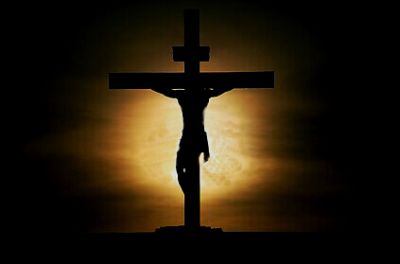 A couple of days ago I published The Challenge to be Christ-Like on the blog Life in Mordor. It’s a group blog that I contribute to. In Luke 23:34, while Jesus is hanging on the cross, he prays “Father forgive them, for they know not what they do.” How can anyone be that Christ like? Perhaps some have given sacrificially, prayed for our enemies, served on the mission field, maybe even given up their own life to save another. Jesus prayed the prayer of intercession for the very people mocking him while they crucified him. And we are commanded to have the same mind in us (Phil 2).
As I have continued to think about this challenge, I am reminded of a couple of things. One, we are never tempted beyond what we can bear. God knows what we are made of, and he has searched and knows each heart. As we learn from Job, the devil is on a leash. Even when he’s the devil, he’s God’s devil. Secondly, and more importantly, is the promise that God’s grace is sufficient to meet each need. His grace provides our daily bread, as Jesus taught us to pray and history demonstrates in Exodus with the heavenly manna. When Elijah asks the widow to feed him (1 Kings 17) she was just about to make one cake for herself, one for her son, and then they were both going to starve to death. By God’s grace, she makes three cakes and they each have a small meal. The next day, there was enough flour and oil for one more day; and the same the next day, and the next day, and the next day. There was always just enough; the Bible never says one morning the bowl was full of flour, nor the bottle full of oil. God’s grace was sufficient daily.
By the way, the original challenge was about being Christ-like to the extreme. I asked who besides Jesus himself could do what he did on the cross. Read Acts chapter 7. As Stephen is being stoned to death, he prays in verse 60 “Do not hold this sin against them.” It’s one of those “With God all things are possible” moments. When the time comes, his grace is sufficient for whatever he has called us to.
Adopted by God
Adopted by God, a 3 point sermon from Galatians 4
I mean that the heir, as long as he is a child, is no different from a slave, though he is the owner of everything, but he is under guardians and managers until the date set by his father. In the same way we also, when we were children, were enslaved to the elementary principles of the world. But when the fullness of time had come, God sent forth his Son, born of woman, born under the law, to redeem those who were under the law, so that we might receive adoption as sons. And because you are sons, God has sent the Spirit of his Son into our hearts, crying, “Abba! Father!” So you are no longer a slave, but a son, and if a son, then an heir through God. – Galatians 4:1-7

We are by nature the enemies of God. Ever since the Garden of Eden, humanity has been prone to do the opposite of whatever it is God wants us to do. Jesus describes us in John 8 as being slaves of sin. It is easily witnessed throughout the history of God’s people in the Old Testament, the struggles of Paul with his own sin nature, and for that mature the course of all history. While in a general sense we are all belong to God, our natural state is like that of the prodigal son. God is watching and waiting for us to come down the road where he will welcome us with open arms. Continue reading
Theological Trivia: Did Animals Talk in the Garden of Eden?
 I used to post occasionally on some of the wacky search terms that led people to my blog, and also what I call trivia question theology. Questions like “Did Adam and Eve have belly buttons?” or “Can God make a rock so big he can’t move it?” Okay, maybe those aren’t real questions, but here is a question that a reader entered into a search engine that was sent to my blog looking for answers.
Could animals talk before the fall?
That’s a legitimate question. Because Genesis describes the serpent as the most subtle of all the animals in the garden. That’s why Satan came to Eve in that form. Eve doesn’t seem surprised when the serpent begins speaking to her. There is a joke that goes like this: Two muffins where sitting next to each other in an oven. When one said “Whew, it sure is getting hot in here” the other said “Whoa! A talking muffin!” If animals did not talk to humans before the fall, it stands to reason that Eve would have reacted differently at the sight of a talking snake rather than carry on a casual conversation with it. When Moses witnessed the burning bush in the wilderness he turned aside to see why the bush was not consumed. It was a curious thing that got his attention.
I try to be real careful about not making the Bible say something it doesn’t say. The Bible does not say the animals could talk. But we do have Eve carrying on a conversation with it instead of either finding Adam and telling him he has to see this, or simply freaking out. We also know that the resulting curse changed things. The relationships between men and women changed, man’s relationship with God changed. Perhaps the animals did talk casually to people before the fall; God did.
More Than Enough
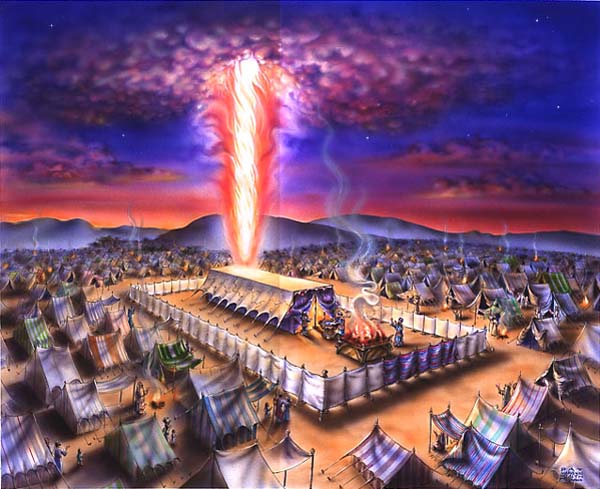
 More Than Enough happens to be a song by Chris Tomlin. It’s about how God’s supply is more than enough for our needs. I’ve borrowed the title, but tonight I was thinking about something other than his song. Take a look at these verses from Exodus 36:
2 And Moses called Bezalel and Oholiab and every craftsman in whose mind the Lord had put skill, everyone whose heart stirred him up to come to do the work. 3 And they received from Moses all the contribution that the people of Israel had brought for doing the work on the sanctuary. They still kept bringing him freewill offerings every morning, 4 so that all the craftsmen who were doing every sort of task on the sanctuary came, each from the task that he was doing, 5 and said to Moses, “The people bring much more than enough for doing the work that the Lord has commanded us to do.” 6 So Moses gave command, and word was proclaimed throughout the camp, “Let no man or woman do anything more for the contribution for the sanctuary.” So the people were restrained from bringing, 7 for the material they had was sufficient to do all the work, and more.
In order to build the tabernacle according to God’s instructions, the Hebrews were asked to donate the materials. Carpenters, goldsmiths and seamstresses were asked to do the skilled labor. In this passage, stuff just poured in until Moses had to command them to STOP giving. Wow. Can you imagine that happening today? What if the ushers had to push people away from the offering plates because they were full? What if the soup kitchen had more food than they had hungry people to feed? What if the local coat closet was busting at the seams, and they ask people to stop giving them winter coats, gloves and scarves? The Hebrews had an abundance of materials because they had basically plundered Egypt as they were leaving. They didn’t steal anything; the Egyptians not only let them leave, they begged them to take whatever they wanted and get out. They were commanded to leave quickly. God provided them with an abundance of loot before asking them to make a donation.
Whatever God asks us to do, he has already provided us with more than enough to do it with. Whether its material, or finances, or talent and ability, God provides for us all we need and more, then asks us to trust him with it. Whatever God has called us to, he equips us to be able to do. Even if we can’t see it yet. God knows what he can do; sometimes he just wants to prove it to us.
Baptism and Re-Baptism
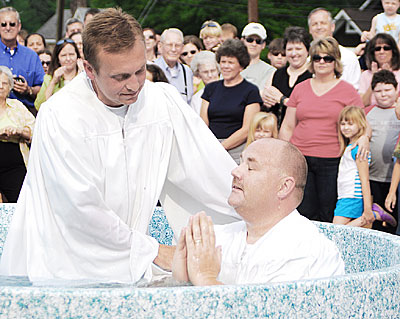 There’s a story in 1 Samuel about the Israelites carrying the Ark of the Covenant into battle with them. They had beaten by the Philistines and wanted a rematch. So they carried the Ark with them into battle so that, in their own words, “it may come among us and save us from the power of our enemies.” Rather than asking God to save them they thought “it” would save them. They confused the symbol with the thing it represented. The symbol is not the thing.* Continue reading
Born Again
(click “watch on YouTube” when prompted)
Text = John 3:1-15
John 3 is a familiar text for those of us that grew up in church. That is exactly the point I mean to get at. When Jesus says the words born again, we know what he means by that. But to a person on the outside looking in, our choice of words can alienate the very people we are trying to reach. Terms like born again, regeneration, converted or even saved have meaning to the Christian believer but require explanation to those not versed in our church jargon. So, perhaps you are trying to find out what it means to be born again. Otherwise, we could all use a reminder from time to time; it helps when explaining it to others. Continue reading
 The Master's Table