
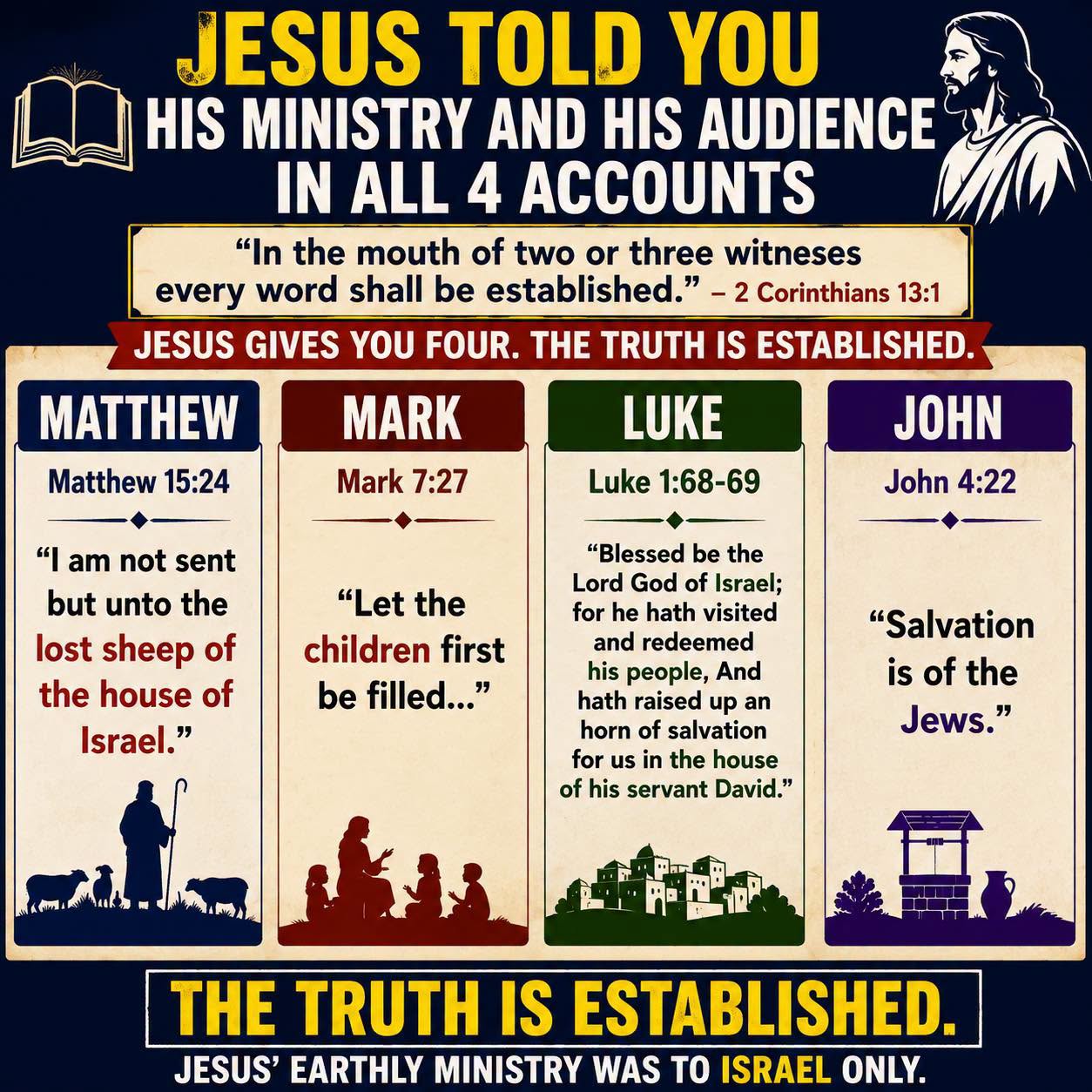
I want to respond to this infographic in a way that is clearly thought out and well organized. During the incarnation, Jesus was an observant Jew. His chosen Apostles were Jews. They kept the Sabbath and the festivals and traveled to Jerusalem when required. But the spirit and intent behind making this image and sharing this particular information is misguided. This is from a person taking a very narrow view of the scripture and encouraging others to do the same.
Let’s begin with context. The verse quoted from Matthew 15 takes place between Jesus and a Cannanite (or Syro-phoennician) woman. It is a test of faith which she passes, leading to Jesus answering her request and healing her daughter. When I pointed this out to the original poster, or at least the person I saw post this on Facebook, the conditions and qualifiers came out. Her claim is that anytime Jesus did something for Gentiles it was as an example to Israel. This woman’s daughter was healed, and the centurion’s daughter was healed, yes because of their faith but more importantly as an example to Israel. They were merely object lessons, Jesus was not ministering to them. Examples are not ministry; at least that was the claim. Jesus marveled at the faith of the Roman centurion, commenting that he had not seen such faith in all of Israel. The verse from Mark is his account of the same conversation with the same woman. Jesus didn’t go throughout Israel telling them his ministry was only to Israel. The quote from Luke was just after the birth of John the Baptst, before Jesus was even born. The prophecy of Zechariah, John’s father, was more about the ministry of John the Baptist than of Jesus. And John 4:22 was Jesus’s conversation with the Samaritan woman at the well. More on that in a bit.
Let’s go back to the Old Testament. God promised Abraham that through him all the nations of the world will be blessed. That is messianic prophecy, all the way back in the book of Genesis. This was before Moses, before the Law, before there was a nation of Israel. God explains to Abraham in Genesis 15 that he is going to make a nation from his descendants. But his promise to Abraham is also that he will “bless those” who bless him (Abraham) and curse those who curse him (back in Genesis 12). And again, that through him all the nations of the world will be blessed (Genesis 22). Israel was God’s chosen people but it was never just about Israel. Why did Jonah not want to go to Ninevah? Because he knew if they repented, God would have mercy on them. He wanted to see them burned like Sodom and Gomorrah. He wished for judgement and retribution. But Jonah eventually went to Ninevah, the capital of the Assyrian empire, and preached a message of God’s judgement which led to repentance… in the capital of Assyria… one of the greatest enemies of ancient Israel in the Old Testament.
Our Christmas story comes from two Gospel accounts, Mattew and Luke. In Matthew there are wise men while in Luke there are shepherds. The shepherds came and worshipped on the night of Jesus birth. They were outside the village of Bethleham, outdoors watching the flocks, all night. These were young men, probably illiterate, certainly poor. The witnessed the sky filled with the heavenly host as the angels proclaimed peace on earth, good will toward men. Contrast these young men, teenagers really, with the wise men who came from afar. These were scholars and astronomers, probably from Persia. They were not only wealthy enough to give fine gifts to Mary and her child but to make a long journey in order to do so. The contrast is great. Young men who came in from the fields near Bethleham to worship, and wealthy, scholarly men who traveled a great distance to deliver expensive gifts. Both both dowed and worshipped because the gospel is for everyone. Remember the Samritan woman in Luke 4? The Samriatans were a sect that had broken away from oxthodox Jewish worship. They had their own scrolls and did not worship in Jerusalem. Jesus told her the time was coming when they would not worship on any particular mountain, in this place or that place, but in spirit and in truth. He gave this prophecy in Samaria, not to the house of Israel. The woman ran and told those in her village she had met the Messiah, and he and his disciples stayed there for two days. And many there believed in him.
The Great Commission is given by Jesus to his disciples to go into all the world and preach the gospel. Now a keen observer will point out this is after the death, burial and resurrection of Jesus. But he was still on the earth in his resurrected body before the ascension, so is this after his earthly ministry? We’re splitting hairs but my point is that the gospel was always meant to go from Israel into the whole world. That was true in the Old Testament, in the Gospel accounts, and we see it happen in the New Testament. On the day of Pentecost there were Jewish worshippers who were not ethnically Jewish from all the known world, that is Europe, Africa and Asia. Christians celebrated Pentecost as the day the Holy Spirit fell but it was already one of the travel festivals which required attendance at the Temple and the reason people were gathered from so many nations. Read the list of those present, in Acts 2:9-11, that each heard the word of God preached in their own native language.
Jesus was a Jew. The disciples were Jews. I said earlier they kept the Sabbath but they were also heavily cristicised for doing things unlawfully on the Sabbath day, including healing people. Jesus came to his own and his own received him not (John 1:11). Jesus earthly ministry took place in Israel (or in the Roman province of Palestine which is today the nation of Israel). But I reject the claim that Jesus’s ministry was only to Israel. It was never just about Israel. In Revelation 21 there will be a city of New Jerusalem. I’m not trying to downplay the significance of Israel, God’s chosen people. But there will also be a new heaven and a new earth, and a multitude that cannot be numbered from every tribe, tongue and nation.